
Place-Only Bets in UK Horse Racing: High-Value Exchange Pricing
 Available in US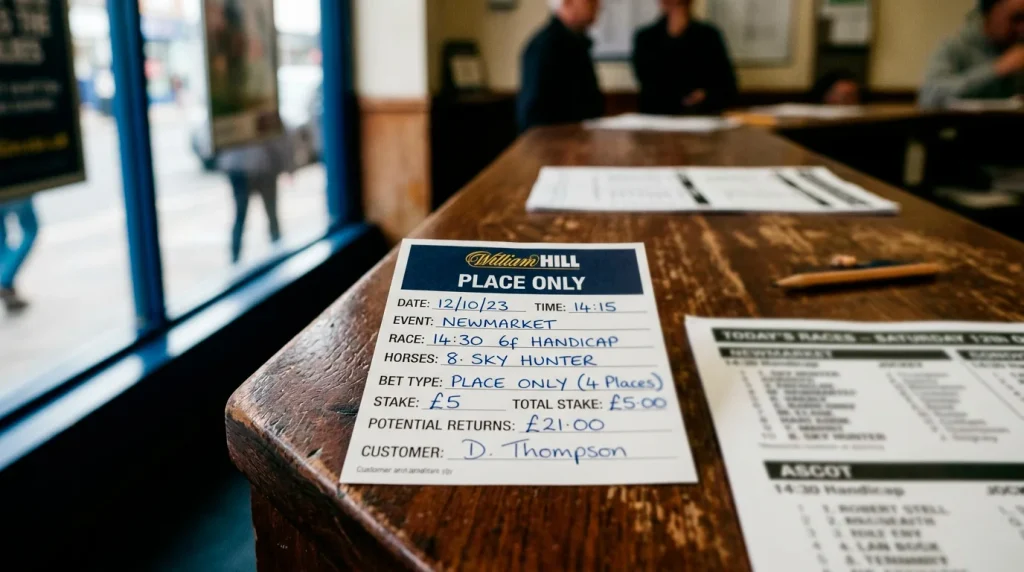
Place-Only Bets: Replicating Exchange Payouts and Pricing
There is a particular kind of bet that punters discover late and wish they had known about a decade earlier. You think a horse will run a big race. You do not think it will win. You want to back the finish, not the winner. On a fixed-odds slip, each-way forces you to pay for a win opinion you do not have. Place-only takes that off the table and lets you bet what you actually believe.
This is a real product, not a workaround. It sits at the seam between fixed-odds and exchange, and the UK is one of the few markets where you can find it on a regulated slip rather than improvising it through stake splits. The £766.7 million in remote horse racing GGY that the Gambling Commission recorded across April 2024 to March 2025 includes a meaningful slice of place-only volume, even if no operator breaks it out in their public results.
The catch is that the place-only market is narrower than the each-way market in two ways: fewer races have it, and the prices are usually shorter than the place leg of an equivalent each-way bet. That second point is what most newcomers find counter-intuitive — surely a place-only price should match the each-way place leg? It does not. The reasons matter, and they are what most of this article is about.
Fixed-odds place-only markets and where to find them
Most UK fixed-odds operators run a “to place” market on the bigger handicaps, the festivals and a rotating set of Saturday cards. It rarely appears on a low-grade Tuesday Core Fixture; it almost always appears on a Cheltenham Festival handicap or a Grand National runner. The economics of running a place-only market are sensitive to volume. Operators only bother where there is enough liquidity in the underlying each-way market to support a separate place line.
On a fixed-odds slip, a “to place” bet treats the place leg as a stand-alone wager at a fixed price. You pick the horse, you choose your stake, and the price you take is the operator’s standalone place price — not derived from the win odds by fraction. That is the structural difference from each-way. An each-way slip builds its place leg by applying 1/4 or 1/5 (per the UK rulebook captured in places like bet365’s published each-way rules) to the win price. A place-only slip just shows a number. The number is set by the operator’s trader.
Where do you actually find them? The festivals are the headline use case — Cheltenham, Royal Ascot, Aintree, York’s Ebor meeting — but they also show up on big domestic Saturday cards. The Wokingham Handicap at Royal Ascot, a 25-30 runner sprint handicap, will routinely have a place-only market quoted hours ahead of the off. So will the Stewards’ Cup at Goodwood and the November Handicap at Doncaster. The pattern is recognisable: deep, competitive handicaps where the operator already manages enough each-way liquidity to support a derivative market.
The number of paid places on a fixed-odds place-only market matches whatever the operator’s each-way terms are for that race. If the each-way is paying five places at 1/5 because of an extra-places promotion, the place-only is paying five places too. You inherit the promotion. That is one of the cleaner reasons to use place-only on a festival handicap — you get the bookmaker’s extra-places offer without paying for the win leg.
The exchange place-only market
The exchange place market is the more interesting venue for place-only betting in the UK because it does not depend on the operator running a side market. It exists by construction, every time the race is competitive enough to attract a back-and-lay book. On Betfair, the place market sits alongside the win market on the same race screen, and it operates on the same matched-bet logic — your back is matched against another user’s lay at the price you both agreed.
The number of paid places on the exchange place market is set by the same rulebook the fixed-odds operators use. Betfair builds its place market from the standard each-way terms, which makes the field-size and race-type rules from the standard UK rulebook the same backbone for both. A 12-15 runner handicap pays three places. A 16-plus runner handicap pays four. A non-handicap of eight or more runners pays three. Below five runners, there is no exchange place market.
What differs is the price. On the exchange, the place price is set by what other users are willing to lay, not by a fraction of the win odds. The result is usually a sharper line — closer to the horse’s true probability of placing — than the fixed-odds place leg. The size of that advantage depends on the race. On a deep, liquid Cheltenham handicap, the exchange place market can sit 15-25% sharper than the fixed-odds each-way place leg, even after the standard commission. On a thin Wednesday Core Fixture, the exchange place market may not exist, or may be quoted with so wide a spread that the theoretical edge evaporates.
For mechanics of the underlying exchange place product — how the order book is built, how non-runners settle, how commission works — the Betfair exchange place markets explainer sets out the structure in full. A place-only bet on the exchange is simply the back side of that market with no win-leg coverage.
Why place-only prices often differ from the each-way place leg
This is the question that confuses every punter who notices the gap for the first time. They look at a 14/1 each-way slip — which pays 14/5 = 2.8/1 on the place leg at one fifth the odds, or 14/4 = 3.5/1 at one quarter — and then they look at the fixed-odds place-only market on the same horse, and they see something like 11/4 or 5/2. Shorter, in both cases, than the fractional derivation of the win price.
The reason is overround. The operator’s place-only market is priced as a standalone book. The bookmaker has to make money across all the runners’ place prices, just as they do across the win prices. The book on a 20-runner handicap might add up to 130-140% in place probabilities (where 100% would be a fair market). That overround is built into every price in the market, including yours. The each-way place leg, by contrast, is mathematically derived from the win price by a fixed fraction. The fraction is generous on long-priced horses and stingy on short-priced ones, but it is not a separate book — the bookmaker’s margin lives in the win price, and the place leg inherits whatever fraction of that margin the rulebook allows.
The upshot is that, on the same horse, the fixed-odds place-only market is usually shorter than the each-way place leg on outsiders and similar or longer on favourites. A 33/1 each-way runner pays 33/5 = 6.6/1 on the place leg at one fifth. The fixed-odds place-only market on the same horse might be 9/2. The each-way place leg is structurally more generous on a longshot than the place-only standalone. The opposite is true at short prices. A 5/1 favourite at one quarter the odds pays 5/4 on the place leg of an each-way. The standalone place-only market on the same horse might be 1/2 — shorter, because the bookmaker’s overround on a favourite eats more of the price.
So the rough rule of thumb: if you want the place leg on a longshot in a big handicap, the each-way slip’s place leg usually beats the place-only quote. If you want the place leg on a favourite, the place-only quote is often the better trade because you save yourself the wasted win-leg stake.
When place-only beats backing each-way
Three situations tip the balance toward place-only over each-way. Short prices is the first. If you believe a favourite at 11/4 will finish in the frame but not win the race, each-way wastes half your stake on the win leg at a price you do not believe in. Place-only at 1/2 or so is the cleaner expression of the opinion. The 2.8% UK problem-gambling rate among horse-race bettors recorded in the Health Survey for England 2018 is the lowest of major gambling categories, and the kind of stake-discipline that place-only forces is part of why — you are betting only what you actually believe in.
The second is exchange access on a deep race. If you can match a place back at, say, 4/1 on an outsider that the fixed-odds book has at 9/2 each-way’s place leg (3.5/1 derived), you take the exchange every time. Both markets are paying the same number of places. The difference is pure price.
The third is the staking-budget case. A £20 each-way bet costs £40 at the till. A £20 place-only on the same horse costs £20. If your bankroll discipline says you bet £20 a race, place-only doubles the number of horses you can cover at the same money. That is a behavioural argument as much as a value argument, but it is real.
When does each-way beat place-only? Longshots in big handicaps with extra-places promotions, almost always. The win-leg stake on a 25/1 horse is not wasted if there is a 5-10% chance the horse wins, and the each-way place leg is mathematically more generous than the standalone place-only on long prices.
Can I bet place-only on every UK horse race?
No. Fixed-odds operators run place-only markets selectively, mostly on big handicaps and festival races. Smaller midweek cards typically only carry the each-way market and the standard win market.
Does place-only count for Best Odds Guaranteed?
In most cases, no. The standard UK Best Odds Guaranteed offer applies to the win leg of each-way bets and to win-only bets. Place-only is usually excluded from BOG, though terms vary by operator.
Why do place-only prices sometimes look generous on outsiders?
Operator place-only markets carry their own overround, but on outsiders the book can leak — the standalone place price sometimes comes out longer than the fractional place leg of an each-way slip. Always compare both before committing.
Articles
Created by the "Racing Place Betting" editorial team.
