
Each-Way Edge: Split Stake Replications on Betfair Exchange
 Available in US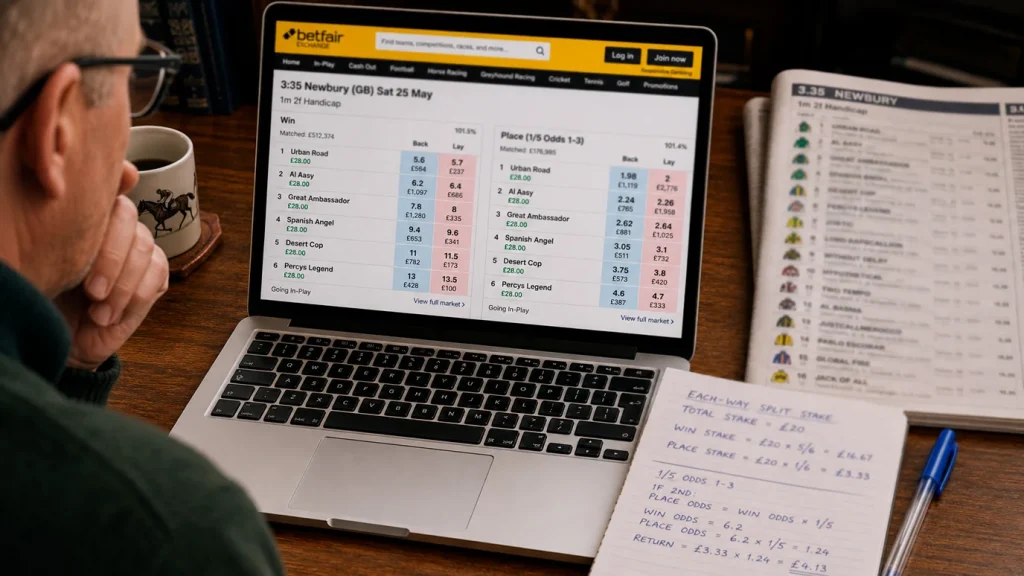
A friend of mine left a long-standing high-street account two summers ago and moved his racing money entirely to Betfair. He was tired of small refusals, irritated by minimum-stake politics, and convinced — correctly, as it turned out — that the exchange would treat his bet history more honestly than the fixed-odds firms had. The first time he asked me how to replicate an each-way on the exchange, he expected a one-button answer. There is not one. There is a manual split of stake between the win and place markets that, executed properly, often returns more than the equivalent fixed-odds each-way slip would have done. Richard Wayman from the British Horseracing Authority has noted that the affordability-check regime has driven larger-staking customers toward exchange-style products in part because the price treatment is fairer to the active punter who is willing to do the calculation.
The exchange does not offer “each-way” as a one-click product. What it offers is two separate markets — win and place — into which you stake separately, and the combined position approximates an each-way slip. The execution is fiddlier. The price is usually better. The bookmaker overround is replaced by exchange commission. And the result is often a noticeably stronger expected return on competitive races.
Splitting the Stake by Hand
I worked this out properly the first time on a Saturday at Newbury, sitting in a coffee shop with my laptop open and the Betfair markets refreshing. The standard fixed-odds each-way splits a slip in half — equal stakes on the win and on the place portion, with the place portion paid at a fraction of the win price. The exchange replica splits the stake in two unequal portions, on two separate markets, with two separate prices.
The cleanest way to think about it: your each-way slip at a high street shop costs you twice the unit stake — say twenty pounds for a tenner each-way — and pays you according to a fixed place fraction on a winner. The exchange replica also costs you twenty pounds total, but you choose how to split it between the win market and the place market based on what each is paying. If the win market is matching a horse at 9.4 and the place market is matching the same horse at 2.6 — these are decimal odds, where 9.4 corresponds to 8.4/1 in fractional and 2.6 corresponds to 8/5 — you can split your twenty pounds in a way that maximises the combined return.
The standard heuristic is to scale stakes inversely to the implied probability of each market, adjusted for the relative payouts. For a 9.4 win and 2.6 place, putting ten pounds on each side replicates the fixed-odds each-way structure roughly. Putting twelve on win and eight on place gives more weight to the win outcome — a higher payout if the horse wins, slightly less if it places. The split is yours to choose, which is the point. The fixed-odds slip removes that choice from you. The exchange replica gives it back.
For UK handicaps where the standard place terms are sixteen-plus runners paying four places at one-quarter — the headline 2025 figure that defines so much of the each-way landscape — the exchange place market is typically backed at decimal odds equivalent to one-quarter to one-fifth of the win price plus stake, occasionally tighter. Commission is charged on net winnings at the prevailing rate, currently five per cent for most customers.
A Worked Replica on a Saturday Handicap
Take a fourteen-runner handicap at Doncaster paying three places at one-quarter on the fixed-odds book. Horse A is priced 8/1 with the bookmaker. Its decimal equivalent is 9.0 — and on Betfair, the win market is currently matched at 9.4 and the place market is matched at 2.7 (which is the place market’s price for the horse to finish in any of the three paid positions).
Fixed-odds each-way: ten pounds each-way costs twenty pounds. A win returns ninety pounds on the win portion plus return of ten-pound stake, plus thirty pounds on the place portion at 2/1 (eight quartered) plus return of ten-pound stake — total eighty pounds win and forty pounds place returned, gross return one hundred and twenty pounds, profit one hundred pounds. A place without win returns the win portion as zero, the place portion as forty pounds returned, net loss of ten pounds on a twenty-pound stake — sorry, that arithmetic is wrong. Let me restate: place-without-win returns forty pounds (thirty profit plus ten stake), with the lost win portion costing ten pounds, so net profit is twenty pounds on a twenty-pound stake. An unplaced finish loses twenty pounds.
Exchange replica: ten pounds on the win market at 9.4, ten pounds on the place market at 2.7, twenty pounds total. A win pays out ninety-four pounds gross on the win market (less five per cent commission on the eighty-four pounds net winnings, taking the win return to roughly eighty-nine pounds eighty net) plus twenty-seven pounds gross on the place market (less commission on seventeen pounds, net place return roughly twenty-six pounds fifteen). Combined gross return roughly £115.95. Profit on the slip is roughly £95.95 — meaningfully less than the fixed-odds win outcome at first glance.
A place without win on the exchange replica loses the ten-pound win stake and returns twenty-seven pounds gross on the place market, less commission of about eighty-five pence, for a net place return of £26.15. Net profit on the slip is £16.15 — comparable to the fixed-odds place-without-win return. An unplaced finish loses twenty pounds, identical to the fixed-odds outcome.
What the exchange has done in this example is offer a slightly more attractive price on the place market (2.7 vs the implied 3.0 from one-quarter of 8/1) and a slightly better price on the win (9.4 vs 9.0). The combined commission drag reduces the win-side advantage, but the place-side improvement is large enough that the place-without-win outcome — by far the most common reason an each-way slip ever returns — pays out competitively against the fixed-odds equivalent.
Where the Replica Beats Fixed Odds
The exchange replica wins on three structural advantages, and recognising them is the difference between using the exchange well and using it badly. The first is price. Backing a horse on the exchange win market gives you access to the matched price set by other punters, which is typically tighter than the fixed-odds shop’s offer — in 2025 figures, fixed-odds bookmaker gross profits ran well above norms in February and March because their margins were thick, and the exchange consistently undercut those margins on liquid races.
The second is the place market price. Fixed-odds each-way prices the place portion at a fixed fraction — one-quarter or one-fifth — applied to the win price. The exchange place market prices the place portion as a separate market with its own demand and supply. On competitive handicaps the place market often offers a higher implied price for the place outcome than the fixed-odds fraction would generate, particularly when the favourite is short and the place pool is heavily weighted toward shorter prices.
The third is the absence of overround. Fixed-odds books bake margin into prices, with place markets routinely running at overrounds of 115 to 125 per cent. The exchange charges commission on net winnings instead, which means liquid races and high-volume punters effectively pay a lower house margin than the equivalent fixed-odds bet would carry. For details on how the exchange place market works as a standalone product rather than as part of an each-way replica, the detailed walkthrough of Betfair exchange place markets covers the liquidity profile and the commission structure in depth.
Where the Replica Quietly Fails
The exchange replica is not always the better bet, and pretending it is would be misleading. It fails in three specific scenarios. First, when the race is illiquid. A small-field midweek handicap with thin matched volumes can produce exchange win prices that look attractive but cannot be filled at meaningful stake. The replica’s advantage evaporates if you can only match a fraction of your intended stake. Second, when the place market is shallow. Some place markets at smaller meetings sit with very little volume, and the price on offer reflects that thinness rather than fair value. Third, when a fixed-odds promotion is active. An extra-places offer at a Cheltenham Festival meeting — where Cheltenham 2025 drew 68.8 million bets across the four days and daily active customers were up 178 to 189 per cent on baseline — gives the fixed-odds book a structural advantage the exchange cannot match.
The replica also fails for very small stakes. Commission on a few pounds of net winnings is a flat-rate drag that compresses the edge to negligible amounts for casual stakes. The exchange replica works best for punters operating at stakes large enough that the percentage commission becomes a small absolute number relative to the price improvement on offer.
When the Replica Is Worth the Fiddle
I run the replica when three conditions line up. The race is competitive and liquid — a Saturday handicap with strong matched volumes on both win and place markets. The fixed-odds place fraction is one-fifth rather than one-quarter, because that is where exchange place prices most reliably beat the implied fixed-odds rate. And the horse I want to back is between 5/1 and 20/1, the band in which the price improvement on both markets compounds into a clearly better return than the fixed-odds slip. Outside that combination I usually take the fixed-odds book, particularly if BOG and an extra-places promotion are both active. The exchange replica is a tool, not a religion. Knowing when to use it and when to leave it alone is more valuable than any single match it produces.
Why split the stake unevenly between win and place markets?
Because the win and place markets are priced independently on the exchange, the optimal split depends on what each market is currently offering. A heavier weighting toward whichever market is offering better relative value boosts the expected return without changing the total exposure. It is a tactical choice the fixed-odds each-way slip removes from you.
Does commission swallow the edge for casual punters?
For very small stakes — under about five pounds total — the percentage commission becomes a relatively flat drag and the replica"s edge shrinks. The replica works best when total stakes are large enough that percentage commission is small in absolute terms relative to the price improvement on both markets.
Do extra-places promotions exist on the exchange in any form?
The exchange does not run extra-places promotions in the same way fixed-odds books do, because the place market is priced by participant demand rather than offered as a promotional concession. Some sponsored markets or boosted-price products appear from time to time, but the structural model of the exchange is not built around promotional terms.
Articles
Created by the "Racing Place Betting" editorial team.
