
Handicap vs Non-Handicap Place Terms: Rules of Market Asymmetry
 Available in US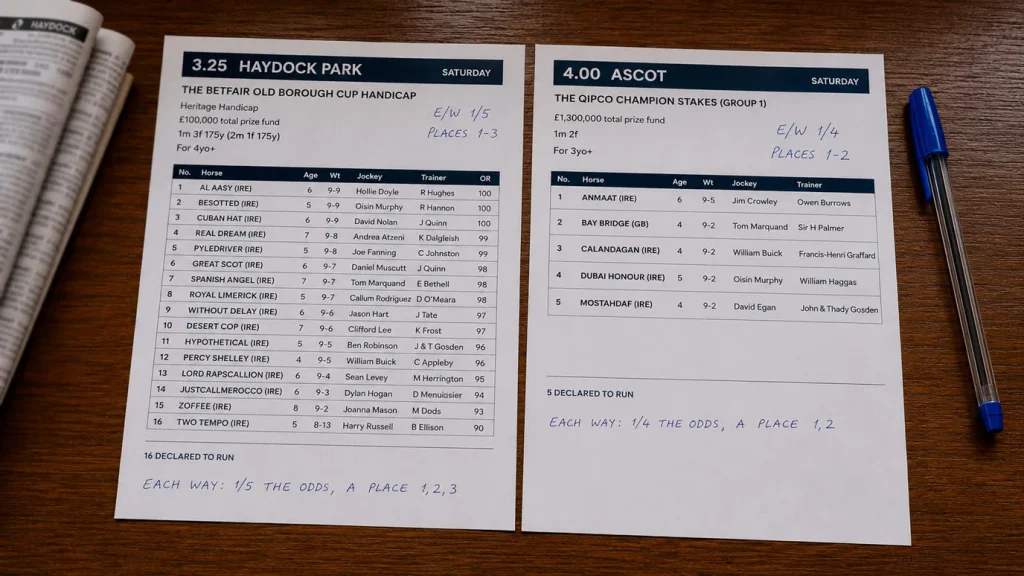
The most expensive mistake I see new each-way punters make is treating every race the same way. They look at the runner count, see eight horses, and assume the place terms must be identical. They are not. A 14-runner handicap and a 14-runner non-handicap can sit on the same Saturday card and pay different place fractions, different numbers of places, and produce wildly different each-way value. The reason is not a clerical accident. It is a deliberate asymmetry that bookmakers built into their books to manage risk on the two race types differently — and once you see it, your each-way decisions start to look much sharper.
Here is the structural baseline I work from. Standard UK fixed-odds terms run roughly as follows: handicaps with sixteen or more runners pay four places at one-quarter; handicaps with twelve to fifteen runners pay three places at one-quarter; non-handicaps with eight-plus runners pay three places at one-fifth; handicaps with eight to eleven runners also pay three places at one-fifth; five-to-seven-runner races pay two places at one-quarter; races with fewer than five runners are win-only. That is the skeleton. The flesh on it is where the asymmetry lives.
What Counts as a Handicap in the UK Pricing Sense
I had a long argument once with someone who insisted a Listed Stakes was a handicap because the runners carried different weights. They do — but not on a handicap mark. The distinction sits at the heart of UK racing and matters enormously for place pricing.
A handicap, in the British racing sense, is a race in which the official handicapper has assigned each runner a weight based on their rating, with the explicit aim of theoretically giving every horse an equal chance of winning. Handicap ratings run on a numerical scale and are reviewed by the British Horseracing Authority on a rolling basis. A non-handicap — which includes Maiden, Novice, Conditions, Listed, Group, and many other categories — sets weights by other rules: age, sex, prior wins, race conditions. The runners in a non-handicap are not flattened toward parity. The favourite is genuinely favoured, and the longshots are genuinely longshots.
This single distinction is why place terms differ. A handicap, by design, has more horses with a credible chance of finishing in the frame. A non-handicap, by design, has a smaller cluster of likely placers and a larger tail of horses with effectively no chance. The bookmaker’s exposure on the place market is therefore higher on the handicap and lower on the non-handicap, so the terms tilt accordingly.
Why Handicaps Quietly Get Better Place Terms
I keep a notebook of races where I have stopped to ask whether the each-way looks generous, and almost without exception the answer comes back: it is a handicap. The 1/4 odds fraction on handicaps is the visible part. The deeper number of places is the structural part. A 16-plus handicap pays four places — almost always meaningfully larger than the three places paid in a non-handicap of the same field size — because the bookmaker is hedging against a much wider distribution of placed runners.
The maths is straightforward when you lay it out. On a sixteen-runner handicap paying four places at one-quarter, a 10/1 horse pays a place return of 2.5/1 plus stake. On a sixteen-runner non-handicap paying three places at one-fifth, the same 10/1 horse pays a place return of 2/1 plus stake. That looks like a small gap until you compound it with the additional fourth place: the handicap structure gives the bettor a meaningfully wider net for a slightly smaller per-position payout, while the non-handicap concentrates payouts at a tighter fraction on a smaller number of placings.
The deeper point is that this asymmetry interacts with field size in ways that reward attentive punters. On a 2025 Flat handicap, where average runner counts sat at 8.90 with Premier Flat fixtures climbing to 11.02, the bookmaker is regularly offering three places at one-quarter — better terms than a non-handicap of the same size. For more on how field-size distinctions shape place terms across UK racing, the detailed structure is mapped out in the breakdown of UK each-way place terms by field size.
How Non-Handicap Place Rules Trip People Up
A non-handicap looks simpler on paper. The favourite is properly favoured. The race shape is clearer. And the terms — three places at one-fifth on an eight-runner non-handicap — feel adequate. But the maths punishes optimism on shorter prices, and the structural floor of five-to-seven runners produces a sharp drop to two places at one-quarter that catches casual punters off guard at Royal Ascot every June.
Here is the trap. A six-runner Group 1, a flagship card race watched by 1.8 million viewers on Gold Cup day at Royal Ascot, falls under the five-to-seven-runner rule. Two places at one-quarter. The 7/2 second favourite — a horse anyone would expect to be in the frame — pays a place return of just over half its win price plus stake. If that horse finishes third, the each-way half of your bet returns nothing because there are only two paid positions. People watch the race, see their horse run a creditable third, and feel cheated. The terms were transparent. The maths was just unforgiving.
The 2025 field-size data underlines how often this trap is set. Across UK racing, twenty-six per cent of races had five-to-seven runners — which means roughly one in four races on a typical card sits in the two-places territory. On non-handicaps, the four-runner floor below which races become win-only catches another tranche of small-field events. A non-handicap is not necessarily worse value than a handicap. It just requires you to read the field size and the race type together, not separately.
What the Asymmetry Means for Value Hunters
Once you internalise the handicap-vs-non-handicap split, every Saturday card starts looking like a sorted shelf. The big handicaps with sixteen-plus runners are where the each-way bettor’s terms genuinely run wide — four places at one-quarter, with extra-places promotions stacking on top during the festival season. The Gold Cup-card handicaps, the Grand National itself with its forty-runner field paying seven places at one-fifth, the Cesarewitch, the Lincoln, the Wokingham — these are the structurally generous each-way fixtures.
By contrast, the non-handicap Pattern races on the same cards — the Group races, the Listed events — concentrate place value on the shorter prices and rarely pay better than three places. The each-way punter who bets a 6/1 outsider in a Group 2 with seven runners is taking on a structure that explicitly does not pay third. The each-way punter who bets the same horse in a 14-runner handicap on the undercard is taking on three places at one-quarter, with a much wider chance of returning a placed-horse stake. Same horse, same odds, very different bet.
The compound point — the one I wish more punters carried into the betting shop — is that handicaps and non-handicaps are different products. They use the same horses, run on the same tracks, and settle on the same race-result feed, but the place terms attached to them reflect very different risk profiles for the bookmaker. The asymmetry is built in. Reading it correctly is the difference between an each-way bet that returns when your horse runs creditably and an each-way bet that needs your horse to actually win for any of your money to come back.
Reading the Race Type Before Reading the Card
My habit now is to read the race title before I read the form. Handicap, novice, Group, Listed — that single word tells me which terms structure applies and where the value lives before I have looked at a single horse. The form work matters. The trainer angles matter. The going matters. But the terms structure is the architecture inside which all that work pays off. A brilliant selection in a six-runner Group is a worse each-way bet than a competent selection in a sixteen-runner handicap, because the terms architecture rewards the latter. Knowing which race you are looking at is not pedantic. It is the first piece of value any each-way bettor can identify without doing any homework at all.
Does a 16-runner Group 1 ever pay four places?
Standard non-handicap terms cap at three places regardless of field size. Some bookmakers run extra-places promotions on flagship non-handicaps — the King George at Ascot, the Champion Stakes — that pay an additional place, but these are promotional concessions on top of the standard book, not a change in the underlying rule. Outside of promotional periods, even a sixteen-runner Group race typically pays three places at one-fifth.
Why do Listed handicaps follow non-handicap rules sometimes?
A Listed handicap is still a handicap and follows handicap place terms. Confusion arises because Listed and Pattern races are often grouped together in racing programmes, but the official race designation as a handicap or a non-handicap on the racecard determines the terms a bookmaker applies. If "handicap" appears in the official title, handicap terms apply.
Can a race be re-classified mid-week?
Race conditions are published when the race is scheduled and do not change in the lead-up. What can change is field size — if non-runners drop a 16-runner handicap to a 14-runner handicap before the off, the place terms shift from four places to three places to match the smaller field. Always check the field size at the off, not the field size on the morning racecard.
Articles
Created by the "Racing Place Betting" editorial team.
