
Ante-Post Each-Way Betting: Maximizing Early Market Odds
 Available in US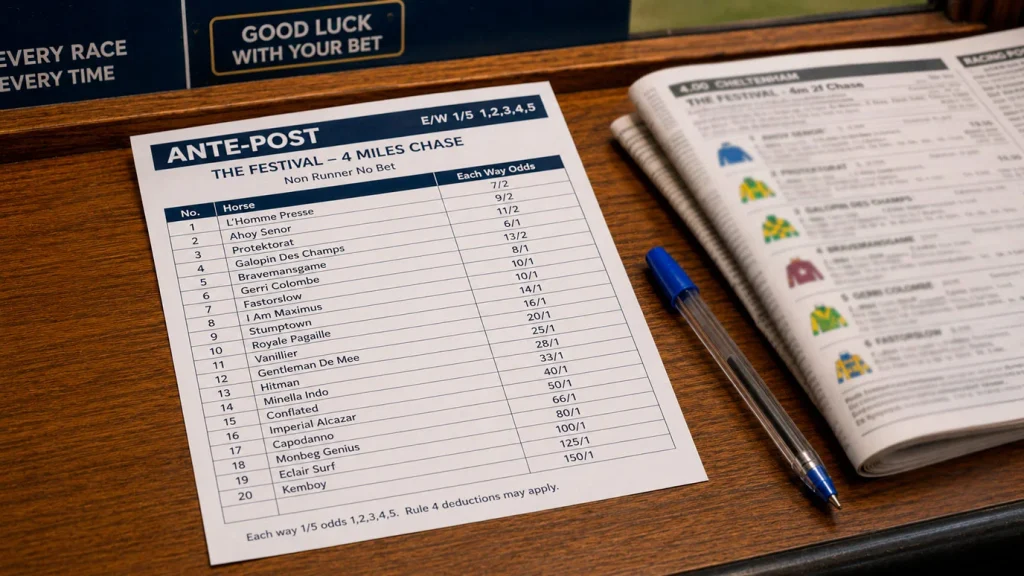
Ante-Post Each-Way Betting: Early Market Odds and Non-Runner Risks
The single biggest bet I have ever struck was an ante-post each-way slip placed eleven months before the race in question. The horse did not run. The slip was on a long-range Cheltenham championship at very generous terms, and the trainer’s plans changed in November. Without NRNB protection on that book, the bet would have been a complete loss. With it, the stake was returned, no harm done. The lesson I took away was not “ante-post is dangerous” or “ante-post is brilliant”. The lesson was: ante-post is a different sport. You are no longer betting the form. You are betting the calendar.
The £250 million wagered on the 2025 Grand National weekend was not all day-of-race money. A meaningful share — operators do not publish the precise split, but industry estimates put it in the 25-35% band — was struck ante-post in the weeks leading up to the race. The Grand National’s ante-post market is open from the previous October. The same is true at Cheltenham: William Hill projected approximately £450 million in total bets across the four days of the 2026 Cheltenham Festival, and a meaningful slice of that money was struck before the four-day meeting even began.
What makes ante-post each-way different from day-of-race each-way is not just timing. It is the trade between three things: bigger prices, more generous place terms, and the structural risk that the horse does not run. The job is to know which of the three you are paying for in any given slip.
Why ante-post prices are bigger
Ante-post prices on UK racing are bigger than day-of-race prices for a structural reason: the bookmaker is pricing a horse that has not yet been declared to run. The operator is taking on the risk that the trainer changes plans, the horse picks up a niggle, the ground goes the wrong way, the entry conditions exclude the horse, the entry stage produces a stronger field than expected. Each of these risks costs the bookmaker. They charge punters for taking them on, but they also have to price the horse generously enough to attract early money — otherwise no one bets ante-post at all.
The 2025 affordability-check context Richard Wayman of the BHA sketched out in his comments on the 2024 Racing Report tells you how the ante-post market has actually evolved in the last two years. He noted that “there are several factors impacting that decline, many of which have nothing to do with the fixture list trial. I’ve no doubt that these are headed by the impact of affordability checks and the extent to which they have resulted in people either stopping betting or placing their bets with unlicensed operators where such checks don’t take place.” That regulatory headwind has pushed bookmakers to compete harder for the punters they have left, and ante-post prices on the headline races have, on average, been more generous in 2025-2026 than they were in 2022-2023. A 16/1 ante-post on a Cheltenham Festival handicap in February 2026 was a longer price than the same horse and same race would have commanded three years earlier.
The size of the gap between ante-post and day-of-race depends on how late the trainer commits to the race. A Champion Hurdle ante-post price on a horse with a clear preparation can be very close to its day-of-race price three weeks out. A Cheltenham Festival handicap ante-post price ten months out can be 50% bigger than the eventual day-of-race price, because the operator is pricing in the chance the horse never makes it to declarations.
The wider point is one Tom Segal — Racing Post’s Pricewise — has been making in print for years: bookmakers pay for early information by giving you a bigger price. The bigger the gap, the more uncertainty they are pricing. The punter’s job is to decide whether they have information the bookmaker does not — or whether they are just paying the operator’s spread on uncertainty for nothing.
The non-runner risk that defines ante-post
Non-runner risk is the structural cost of betting ante-post. If you take a 25/1 each-way slip on a Grand National runner three months before the race, and the horse is balloted out at the entry stage, the slip is dead unless the book is NRNB. The same is true if the horse picks up an injury, if the trainer reroutes to a different race, if the owner withdraws the entry. There are dozens of routes out of a race, and ante-post each-way punters are exposed to all of them.
NRNB protection neutralises this risk for the price of slightly tighter terms. On a major UK race with NRNB applied — Grand National, Cheltenham Festival championships, Royal Ascot Group 1s — the operator covers non-runner risk by refunding the stake in full if the horse does not start. The book is priced to absorb this cost, so NRNB prices are typically 10-20% shorter than non-NRNB ante-post prices for the same race. A 25/1 non-NRNB ante-post might be 20/1 with NRNB. The shorter price is the cost of the protection. For most punters that is a trade worth making; the structural details of NRNB on each-way bets, including which races and operators offer it, sit alongside this article.
Where NRNB is not offered, the punter is fully exposed. The classic case is mid-grade Cheltenham December meetings — Sandown’s Tingle Creek, Newbury’s Hennessy weekend, Kempton’s Christmas card — where ante-post markets exist for weeks ahead but the operator does not run an NRNB book until the final declaration stage 48 hours before the race. The prices in those windows are bigger than NRNB prices would be, but the punter is paying for that with the structural risk of the horse not running.
I have, over the years, drifted toward NRNB on virtually all my ante-post each-way bets. The exception is when the form case is so strong that I am willing to absorb non-runner risk for a substantially bigger price. Most of the time, the operator has priced that gap correctly, and NRNB is the better trade.
How place terms shift between ante-post and day-of-race
The interesting structural quirk of ante-post each-way is that place terms can move in either direction between the day you place the bet and the day the race runs. On the headline races, the movement is usually toward more generous terms — the operator announces extra paid places as a promotion in the final fortnight, and ante-post slips inherit the new terms automatically. The 2026 Grand National’s Sky Bet offer of seven each-way places at 1/5 odds — the most of any major UK operator — would have been applied to ante-post slips placed at earlier and less generous terms in the months leading up to the race.
The reverse case is rare but real. On a mid-grade Cheltenham non-handicap, ante-post terms might be three places at one fifth based on the operator’s assumption of a competitive field. If the race declares with seven runners on the day, place terms drop to two places at one quarter — and ante-post slips are repriced to the new terms. The structural rule is that day-of-race terms govern; ante-post slips are not locked at the terms taken.
The 2025 Cheltenham Festival saw exactly this asymmetry in operation. The 28 races over four days drew 68.8 million individual bets under Optimove’s tracking, with first-time deposits surging 310-417% during Cheltenham 2025 compared with a neutral week. The operators with the most generous extra-places promotions captured the lion’s share of that surge, and ante-post each-way punters who had taken modest terms in January 2025 had their slips upgraded to the promotional terms by Festival week. That asymmetry — terms improve more often than they tighten — is one of the structural reasons ante-post each-way on headline races has been a reasonable strategy in recent years despite the non-runner risk.
Case studies: Grand National and Cheltenham ante-post
The Grand National is the cleanest test case. The 2025 race generated £250 million in betting turnover over the weekend, with the single race producing 700% more betting activity than the Cheltenham Gold Cup. Ante-post each-way markets on the National open in the previous October — six months before the race — and prices in that window are generous because trainers’ plans are fluid. A horse priced at 33/1 in October might be 20/1 by January if it runs well in trials, and 14/1 by race week if it produces a key prep run.
The mechanic for the ante-post punter is to take the price when conviction is highest. If you fancy a horse in October at 33/1, your each-way slip locks in the win-leg price at 33/1 and the place fraction at whatever the ante-post place terms specify. Day-of-race terms may upgrade those place terms — for the 2025 National, most major UK firms offered six paid places where the standard rulebook would have suggested four, and Betfred uniquely offered seven places at 1/5 odds, leading the market. Ante-post slips were upgraded to whichever terms the slip’s host operator announced.
The Cheltenham Festival is the more complex case because the place-term shifts span 28 races across four days. The 2025 Festival saw all 28 of its races rank in the top 31 most-bet-on horse races in the UK that year. Inside that volume, the typical ante-post each-way pattern is: take a price in February when the field is taking shape, accept the basic place terms in the slip, and let the operator’s day-of-race promotion upgrade those terms as Festival week approaches. The risk is that the horse fails to make declarations or runs in a different race; the reward is a bigger price than the day-of-race book ever quotes plus the inheritance of any promotional place terms the operator announces in the final fortnight.
Do I lose my ante-post each-way stake if my horse doesn"t run?
Only if the book is not NRNB. On NRNB ante-post markets, your stake is refunded in full when the horse does not start. On non-NRNB ante-post markets, the stake is lost as a settled bet on a non-running horse.
When do bookmakers usually convert ante-post to day-of-race terms?
At the final declaration stage, typically 48 hours before the race. After declarations, the day-of-race rulebook governs and slips inherit whatever place terms the operator quotes on the day, including any extra-places promotions.
Are ante-post place terms ever worse than day-of-race?
Rarely, but yes. If a non-handicap declares with fewer runners than the ante-post market assumed, the place terms drop to the smaller-field tier. Ante-post slips are repriced to whatever the day-of-race terms specify.
Articles
Created by the "Racing Place Betting" editorial team.
