
Each-Way Doubles and Trebles: Multi-Leg Payout Accumulation
 Available in US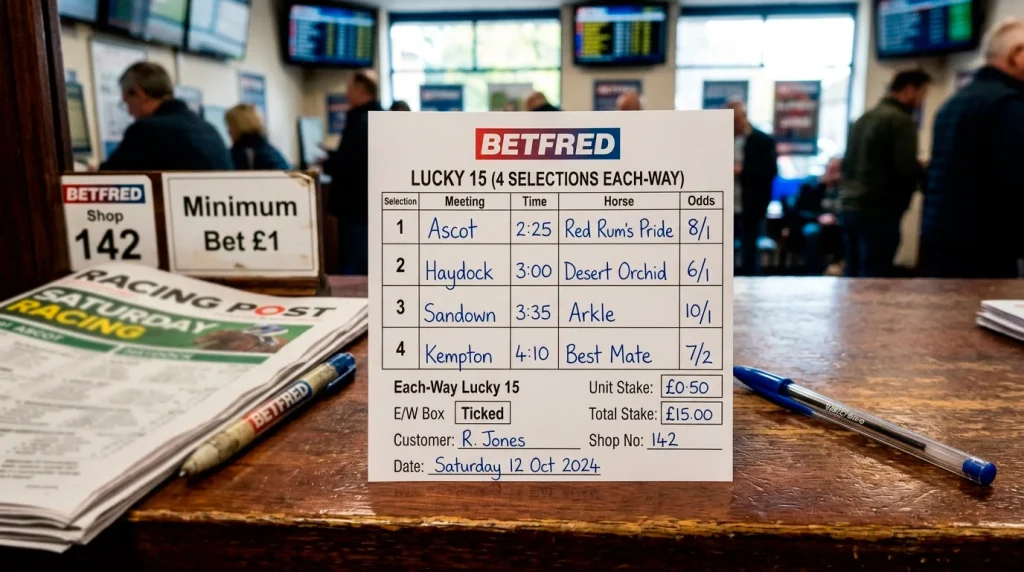
Every Saturday lunchtime, somewhere in a UK racing shop, a punter hands over a slip with three each-way selections combined as a treble and asks the cashier to “put it on each-way.” The cashier marks it up. The slip prints. The punter pockets it. And eight hours later, almost without fail, they come back asking why a slip that looked like a winning combination actually returned less than they expected — or in many cases, returned nothing despite multiple horses placing. The each-way multiple is one of the most popular bet structures in the UK and one of the most consistently misunderstood. The annual £766.7 million of horse-racing online GGY in 2024-25 includes a large slice driven by multiples — and a large slice of that is settled below punter expectations because the settlement logic is genuinely tricky.
I will say this directly. An each-way multiple is not one bet. It is two distinct bets running in parallel — a win multiple and a place multiple — and they settle independently of each other. Understanding that one fact rescues every settlement question that follows.
How an Each-Way Double Actually Settles
I worked through this with a friend over coffee after his bet got “robbed” — his words — on a Saturday afternoon. He had backed two horses each-way at 5/1 and 8/1, both ran respectably, one won and the other was a clear second. He expected a substantial return from the double. He got the equivalent of two singles paid each-way separately, except worse, because that is not what a double does.
An each-way double is structurally a win double plus a place double, each settled on the same selections. The win double pays only if both horses win. The place double pays only if both horses place (which includes a win, since a winner is by definition placed). If one horse wins and the other places without winning, the win double loses entirely — and the place double pays on both selections at their respective place fractions compounded together.
Take that worked example. Two horses backed each-way at 5/1 and 8/1, both in fourteen-runner handicaps paying three places at one-quarter. Stake is five pounds each-way, totalling ten pounds. The win double would have paid 6 × 9 = 54 times stake, returning twenty-seven pounds five times — call it £270 — but it loses because horse two didn’t win. The place double settles at 5/1 quartered times 8/1 quartered, which is 2.25/1 times 3/1 compounded — multiplied out as 1 + 2.25 = 3.25 times 1 + 3 = 4 = 13 times stake on the place portion. Five pounds on the place double returns sixty-five pounds against a five-pound place stake. The full slip returns sixty-five pounds against ten pounds — a profit of fifty-five pounds. Not £270, but a long way from nothing.
The structural point is that each-way doubles, trebles and bigger multiples need every leg of the place portion to come in for the place portion to pay. One unplaced leg kills the place portion entirely, even if the others won. That is the asymmetry. A win double needs two winners and pays large. A place double needs two placed horses — winning included — and pays smaller. Lose either, and the relevant portion of the slip is dead.
Trebles and Longer Multiples — Where the Math Gets Punishing
Add a third leg and the place portion’s hurdle rises sharply. The standard UK place terms at one-quarter or one-fifth mean the cumulative place probability on a treble is the product of three individual place probabilities, which compresses quickly. Three horses each with a 35 per cent chance of placing — credible estimates for moderate-priced runners in competitive fields — produce a place treble probability of roughly 4.3 per cent. Reasonable per leg. Marginal as a treble. Three legs at 10/1 each in non-handicap eight-runner fields with three places at one-fifth produce a place treble probability that is genuinely small.
What matters for the settlement math is that the place fraction is compounded across legs. A 10/1, 12/1, 14/1 treble each-way at one-quarter terms compounds the place portion to 3.5/1 × 4/1 × 4.5/1 — multiplied out, that is 4.5 × 5 × 5.5 = 123.75 times stake. A five-pound place treble that hits returns roughly £620. Big number. Tiny probability. The win treble on the same combination would pay 11 × 13 × 15 = 2,145 times stake — three thousand pounds and change from a five-pound place stake. The each-way multiple makes longshot treble place returns into life-changing payouts at very long odds, but the probability of three longshots all placing is correspondingly low.
This is where a lot of casual each-way multiple punters go wrong. They look at the win-multiple return and feel they have hedged the bet by paying the place portion. They have not, in any meaningful sense. They have placed a separate, lower-return bet on a lower-probability event — three placings rather than three wins, but still all three. There is no insurance. There is a parallel bet running alongside.
To-Place-Only Multiples and Variant Structures
Some bookmakers offer a place-only multiple as a distinct product, where the punter pays only the place stake and the win portion does not exist. This is structurally honest in the sense that it removes the win-multiple liability that an each-way double or treble carries. It also concentrates the bet entirely on the place outcome — three legs, three placings required, with no protection if one horse wins clearly and the others place.
The to-place-only treble at one-quarter terms on three 8/1 horses returns roughly 3 × 3 × 3 = 27 times stake if all three place. A ten-pound stake returns £270 against a ten-pound bet — much higher than a place-only single but requiring three concurrent placements, including in fields that may have shrunk to the 2025 average of 8.9 runners on the Flat or 7.84 on the National Hunt. The smaller field size compresses the place probability per leg and pushes the combined treble probability further down.
For a clean step-by-step on how each leg of the place portion settles into the compound figure — including dead-heat adjustments inside multiples — the worked breakdown in the each-way calculator explained sets out the formula for any combination of place fractions and number of legs.
Variance, Stake Size and the Sensible Hand
The Lucky 15 is the structure that pulls all this complexity into a single slip — four selections combined as four singles, six doubles, four trebles and a fourfold accumulator, totalling fifteen bets. Run each-way, that doubles to thirty bets. A pound each-way Lucky 15 commits thirty pounds, and the settlement logic asks for every single leg to be tracked through every multiple it appears in. Most cashiers and most online slips automate this correctly. Most punters cannot mentally reconstruct the settlement without help.
What I see consistently is that punters who like multiples treat the each-way version as variance protection. It is not. It is variance amplification on the long-tail outcomes — the slip that pays nothing far more often than a singles-only approach, with occasional outsized hits when the place portion of the compound bet aligns. The expected return on an each-way Lucky 15 is roughly equivalent to fifteen separate each-way bets weighted toward the compound structure. If you bet for variance reduction, multiples are the wrong instrument. If you bet for occasional big hits at smaller stakes, the each-way multiple is doing what you want, but you should size the stake to the variance, not to the hoped-for return.
A practical rule I follow: I will run each-way doubles when both selections sit in the longer-priced bracket of 6/1 to 16/1 and both fields are competitive handicaps with strong place terms. I will rarely run each-way trebles outside of an accumulator-friendly festival card with extra places attached. I will treat any each-way multiple structure shorter than 5/1 per leg as money the bookmaker has structurally engineered to lose, exactly as a short-priced each-way single is.
What the Slip Tells You at the End of the Day
Each-way multiples are a legitimate and sometimes profitable bet structure for punters who understand the architecture. Two parallel bets — a win multiple and a place multiple — each with their own settlement logic, neither of which protects the other against the loss of a leg. Lose a winner from a win multiple and the win portion is gone. Lose a placed horse from the place multiple and the place portion is gone. Run all the maths through and the each-way version is genuinely paying out a smaller compound return on the place legs in exchange for the chance of a much larger compound win-multiple return when every horse wins. Knowing which of those outcomes is plausible on the bet in front of you is the difference between a sensible flutter and a slow donation.
Does my each-way double pay if one leg wins and one only places?
The win portion of the double loses because the leg that only placed did not win. The place portion of the double pays on both selections — the winning leg is also a placed horse for place-double purposes — at the compounded place fraction across both legs. The slip returns a profit, just not the headline win-double figure.
How is a Lucky 15 settled when bet each-way?
An each-way Lucky 15 splits into four each-way singles, six each-way doubles, four each-way trebles, and one each-way fourfold — a total of thirty bets. Each individual win and place multiple settles independently. The total return is the sum of every winning slip-line within the structure.
Do extra-places promotions apply inside each-way multiples?
Most bookmakers apply extra-places promotions to each leg of a multiple individually. So a Cheltenham Festival each-way treble with extra-places on each leg settles the place portion at the enhanced place terms for each qualifying leg. The specific rules vary by operator, and the terms attached to the promotion always override the standard book.
Articles
Prepared by the Racing Place Betting editorial staff.
