
1/4 vs 1/5 Odds Fractions: Payout Variance and Value Adjustments
 Available in US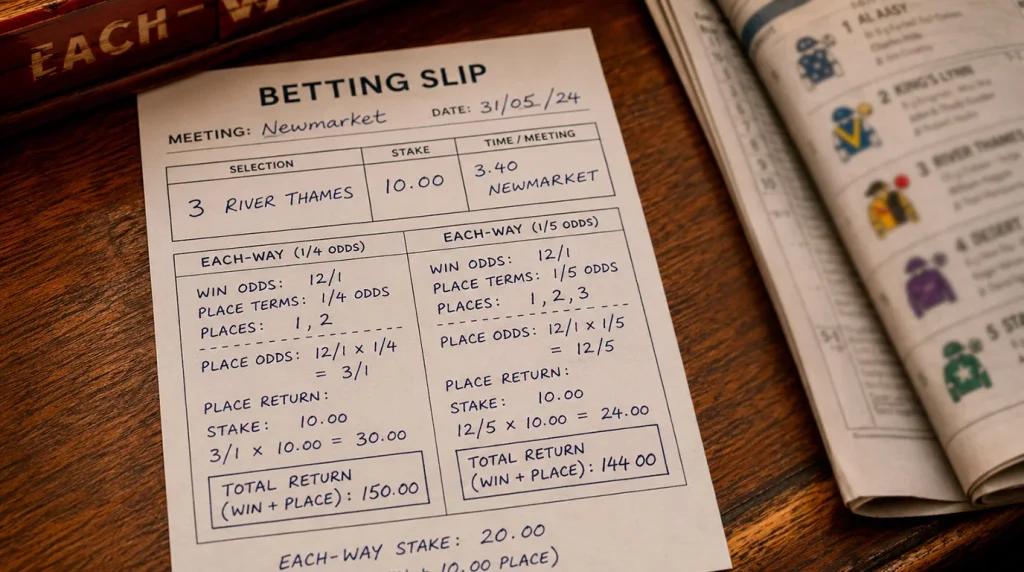
1/4 vs 1/5 Odds Fractions: Place Leg Payout Variance
I once watched two punters compare notes after a 12-runner Wolverhampton handicap. Both backed the same horse each-way at 10/1. Both got a place. Both expected the same return. One walked away with about £35 on a fiver; the other had £45. They were not on different slips — they were on different operator rulebooks at the same field size. One had taken his bet at one quarter the odds, the other at one fifth. Same horse, same finish, same stake, different fraction. The difference at the till was 25%.
The number of paid places gets the headlines, but the fraction is the line item that quietly decides how much the place leg of your bet is actually worth. Bookmakers will happily plaster “5 places paid” or “6 places paid” across a Saturday handicap and bury the fraction in a footnote. Read the footnote. A 16-runner handicap at one quarter the odds will out-pay a six-place promotion at one fifth on a short-priced runner more often than punters expect.
Sky Bet’s headline offer of seven places at one-fifth odds on the 2026 Grand National — the most generous of any major UK operator — only makes sense once you can sit down and convert the fraction into pounds. That conversion is the entire job of this article. The standard UK fraction tiers all sit inside bet365’s published each-way rules, which serve as the de facto industry reference, and every operator’s slip follows the same logic underneath.
Where 1/4 the odds applies
One quarter the odds is the original UK fraction. It applies to fields where competition is genuinely tight and the bookmaker is happy to pay a bigger slice of the win price for a finish in the frame. There are three standard tiers where 1/4 fires under the default UK rulebook.
The first is small fields. In races of five, six or seven runners — handicap or non-handicap, Flat or Jumps — each-way pays two places at one quarter the odds. The bookmaker is paying you 25% of the win price for picking one of the top two finishers in a six- or seven-horse field, which is a reasonable swap when the runners are evenly weighted and the maths is on the operator’s side.
The second is mid-sized handicaps. In handicaps of 12 to 15 runners, the rulebook pays three places at one quarter the odds. The thinking is that a 12- to 15-runner handicap is a genuinely contested race — weight-adjusted, often deeply ranked — and the place market needs a fraction that respects how hard it is to land a third place there.
The third is the big handicap tier. From 16 runners upwards in a handicap, four places are paid at one quarter the odds. This is the most generous standing tier in UK racing. A 24-runner handicap at Cheltenham, an Ebor field at York, a 30-plus runner Wokingham at Royal Ascot — all of these sit in this band. The Grand National itself, with up to 40 runners, has historically built on this tier with extra-place promotions that take paid places up to six or seven while keeping the fraction at one-quarter or stretching it to one-fifth depending on the operator.
Where 1/5 the odds applies
One fifth the odds is the fraction the bookmaker reaches for when the race is harder to read. In conditions stakes — Group races, Listed races, non-handicaps generally — favourites tend to be more concentrated, place markets tend to settle more predictably, and the operator narrows its place payout accordingly.
Under the standard rulebook, one fifth the odds applies to non-handicaps of eight or more runners, paying three places. That covers Group 1, Group 2, Group 3, Listed and conditions races, plus your standard novice hurdles and maidens. Every Royal Ascot Group race on the card lives here. So does every Cheltenham Festival championship race. Race builders argue that the form lines in these contests are tighter, the favourites are usually shorter and the place market is more clinical, so the place fraction needs to reflect that.
One fifth also creeps into handicaps when an operator runs an extra-places promotion. The trade-off there is explicit: the bookmaker pays you more places — five, six, sometimes seven — but lowers the fraction from one quarter to one fifth. Whether that swap is in your favour depends entirely on the price of your horse and how often a runner at that price finishes inside the extra paid place. Industry analysis suggests an extra place on a competitive 20-runner each-way race expands the place “net” by roughly 25%, which sounds generous on paper but only converts to value when applied to genuine 16/1-plus shots in real handicaps. A short-priced favourite at 7/2 in the same race rarely benefits.
I will be blunt about this. Anytime a UK firm advertises “extra places at 1/5”, the first question to ask is whether the 1/5 fraction has dragged value out of the place leg that the extra place does not give back. On short-priced horses, it usually has. On longshots in big competitive handicaps, the extra place can comfortably win the trade.
Comparing the two on a £10 each-way 10/1 shot
Take a £10 each-way bet on a 10/1 shot. The £10 stake doubles at the counter to £20 — £10 on the win leg, £10 on the place leg. The win leg is identical under both fractions: if the horse wins, you get £100 profit plus your £10 stake, £110 total from that leg.
Now run the place leg twice, once at each fraction. At one quarter the odds, your place price is 2.5/1. Apply that to a £10 place stake: £10 × 2.5 = £25 profit, plus your £10 stake returned, £35 from the place leg. At one fifth the odds, your place price is 2/1. Apply that to a £10 place stake: £10 × 2 = £20 profit, plus your £10 stake returned, £30 from the place leg.
So on a finish in the frame without winning the race, your £20 outlay returns £35 at one quarter or £30 at one fifth. That is a £5 swing. On a longer price the swing widens. At 20/1, one quarter places at 5/1 and one fifth places at 4/1 — a £10 swing on the same £10 place stake. At 33/1, one quarter places at 8.25/1 and one fifth places at 6.6/1, a £16.50 swing. The longer the price, the more the fraction matters in absolute pounds. That is why operators willingly trade fraction for extra places on long-priced fields like the Grand National: they know the absolute pound-cost of moving from 1/4 to 1/5 is largest on the kind of horses big-field handicaps invite.
Non-standard fractions: 1/6 and 1/3 cases
One quarter and one fifth cover the vast majority of UK each-way racing, but the rulebook does flex at the edges. The two fractions you will sometimes meet outside the standard are one sixth and one third.
One sixth turns up in two contexts. The first is some festival extra-places promotions where the operator stretches paid places to six or seven and trims the fraction down to compensate. The 2026 Grand National’s Sky Bet offer of seven places at 1/5 sits at the limit of the standard fractions; a small number of niche operator promotions have been seen as far down as 1/6 on extreme paid-places offers. The trade is brutal on short prices. The 2025 Grand National saw Betfred as the only major firm offering seven places at one fifth, which made it the headline number — but the same race at one sixth would have given the place leg of a 25/1 outsider a much shallower fraction to work with. Reading promotions, look for fraction before counting places. For the field-size tiers and how the standard fractions map onto runner counts in detail, the UK place terms rulebook by field size sets out which tier applies where.
One third appears in a different setting entirely — it is the standard place fraction in many continental European each-way markets and in some UK ante-post specials on long-range Group races and the Classics. Where 1/3 is offered, you are usually paying for it in fewer paid places (often only two) or in a tighter price. The reality is that 1/3 is rare on day-of-race UK fields. If you see it on a slip, check that you are not looking at an ante-post offer with terms that will be replaced when the race finalises.
Fractions outside this range — 1/2, full odds, anything else — do not exist as a place leg on a regulated UK each-way market. If you see them, the bet is being settled as something other than a standard UK each-way, and the rulebook applies elsewhere.
Does the fraction ever change mid-race?
No. The fraction is locked at the moment the bet is placed and shown on the slip. Late withdrawals trigger Rule 4 on the price, but the fraction itself does not move.
Why are some festival promotions 1/5 in races that would normally be 1/4?
Operators lower the fraction from 1/4 to 1/5 to fund extra paid places. They pay more places for the same outlay by trimming what each place is worth, which favours longshots and works against short-priced runners.
How is the fraction shown on a betting slip?
It is printed alongside the place terms, typically as a single line stating the places paid and the fraction — for example, 4 places, 1/4 the odds. Read this line before the bet confirms.
Articles
Prepared by the Racing Place Betting editorial staff.
