
Each-Way Calculator Payouts: Exact Win and Place Return Formulas
 Available in US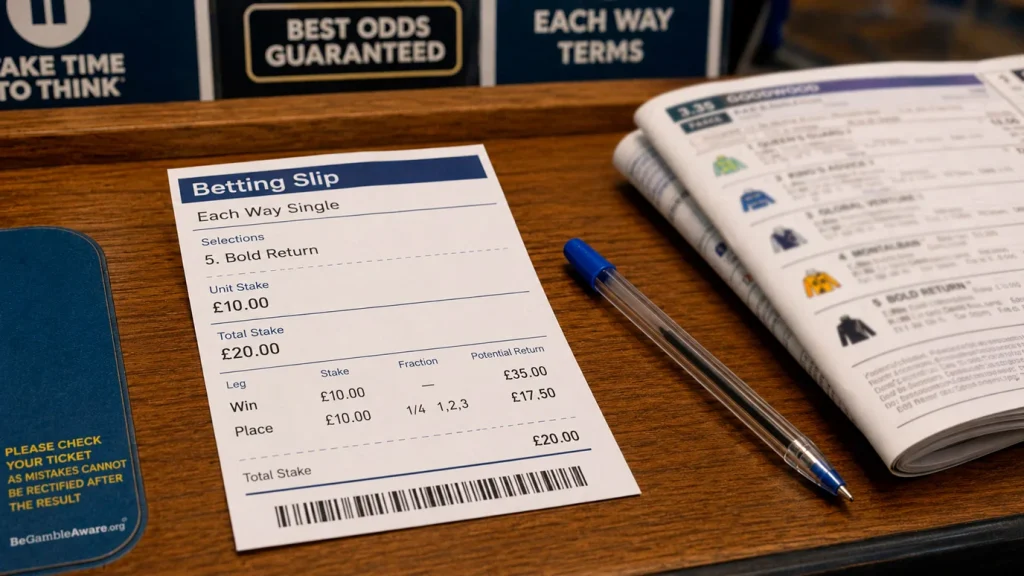
Each-Way Calculator Returns: Win and Place Part Math Breakdown
Every each-way calculator on the internet runs the same five-line piece of arithmetic underneath. The only thing the prettier ones add is colour-coded buttons and the option to fill in a Lucky 15. The maths is the maths. If you understand the five lines, you can ditch the calculator entirely on a single bet, and you can spot the moment the calculator is lying to you on a multiple.
The reason this matters is volume. UK remote horse racing betting cleared £766.7 million in GGY across April 2024 to March 2025, and a large slice of those bets are each-way. Each one of those bets goes through some version of the calculator, whether at the till in a shop or inside the operator’s settlement engine. The output the punter sees in the app is a single line — “potential return £x” — and most punters never check it.
I have watched friends pat themselves on the back over a calculator output that, on closer look, missed the place fraction by a factor of two. I have also seen pros refuse to trust an in-app calculator for an each-way Lucky 15 because they had been bitten by one operator’s settlement quirk three years earlier. The calculator is a useful tool. It is not a clever one. The mistakes are usually input mistakes, not formula mistakes, and they go undetected because the punter does not know what the formula is supposed to look like.
The five inputs that drive the maths
Five inputs. That is all an each-way calculator needs. Stake, win odds, place fraction, paid places and finishing position. Every other field on the calculator screen — bonus boosts, free-bet stake-not-returned toggles, BOG checkboxes, Rule 4 deductions — is an overlay on top of those five. Get the five right and the rest is plumbing.
Stake is the unit per leg. Enter £5 each-way and the calculator should be doubling it internally — £5 on the win leg, £5 on the place leg, total outlay £10 — before it does anything else. Plenty of new punters input £10 expecting the calculator to split it, and walk away with returns that look twice what they should be.
Win odds is the headline price on the slip. Most UK calculators handle both fractional (10/1) and decimal (11.00) formats. The number itself is the same fact in different clothing.
Place fraction is the line every calculator should make you select explicitly. It is either 1/4 or 1/5 in 99% of UK racing, set by the standard place terms published in operator rulebooks like bet365’s help centre. The fraction is not optional. Choose wrong and the place leg comes out by 25% in either direction.
Paid places is the count of finishing positions that pay the place leg. Five, six and seven appear on extra-places promotions, but the calculator should still ask. The 2026 Grand National’s Sky Bet offer of seven paid places at one-fifth odds, the most generous standing offer of any major UK operator that year, only works in the calculator if you tell it seven.
Finishing position is the simplest input and the easiest to lie to yourself about. Tick “won” and both legs settle. Tick “placed” and only the place leg settles. Tick “unplaced” and nothing settles. The calculator does the rest.
The formula walkthrough, line by line
Take a £10 each-way bet on a 14/1 shot in a 20-runner handicap with extra places: five paid places at one-fifth odds. The horse finishes fourth. What is the return?
Line one: total stake. The £10 each-way doubles at the till. Total outlay £20, made up of £10 on the win leg and £10 on the place leg. The calculator stores these two figures separately for the rest of the run.
Line two: win leg settlement. The horse did not win the race. The win leg returns £0. The £10 win stake is lost. If the horse had won, line two would have generated £10 × 14 = £140 profit plus the £10 win stake, £150 total from the win leg.
Line three: place price calculation. The place fraction is one fifth. One fifth of 14/1 is 2.8/1. Internally, calculators handle this by dividing the fractional win price’s numerator: 14 ÷ 5 = 2.8. The place return at the till is at decimal price 3.8 (which is 2.8/1 plus the returned unit). If the calculator is using decimals throughout, it does the same operation differently: a decimal price of 15.0 (which is the same as 14/1) converts to a place decimal of ((15.0 – 1) ÷ 5) + 1 = 3.8.
Line four: place leg settlement. The horse finished fourth, inside the five paid places, so the place leg fires. £10 place stake × 2.8 place price = £28 profit. Plus the £10 place stake returned, £38 total from the place leg.
Line five: total return. Win leg £0 plus place leg £38 equals £38. The bet returned £38 on a £20 outlay. Net profit £18. The calculator will display that single £38 number, sometimes broken down into “place return £38” alongside. If the horse had won, the total would have been £150 + £38 = £188, broken into the two legs internally but presented to the punter as a single sum. Every UK each-way calculator does this same five-line dance. The variations across operators are cosmetic. The arithmetic is the same arithmetic the place fractions impose on the maths in any direction you push the inputs.
How a calculator handles a dead heat
Dead heats are the one place where most quick calculators go quiet. The rule is straightforward in principle: when two or more horses share the same finishing position and one of them is your each-way runner, the place stake is divided by the number of horses sharing that position. The British Horseracing Authority’s racing director Richard Wayman, talking about the 2024 BHA Racing Report, put it succinctly enough — “we wanted to make our best racing better and use that as our tool to grow interest in the sport” — and the place market’s tight settlement rules are part of why that interest survives the small-field years.
Take a 16-runner handicap that pays four places. Your 10/1 shot finishes fourth, but it dead-heats with another horse for fourth — there are now five horses across the finishing positions one through four, and two of them are sharing the last paid place. Under UK rules, your £10 place stake is treated as £5 winning at the full place price and £5 lost. The win leg, if the horse won, is unaffected — dead heats for the win are vanishingly rare and trigger their own separate divisional rule that most calculators handle correctly.
On a place dead heat for our £10 each-way 10/1 shot in a 16-runner handicap (1/4 the odds, four places paid), the place leg works out as follows. Place price is 10/1 ÷ 4 = 2.5/1. £5 wins at 2.5/1 = £12.50 profit plus £5 stake returned = £17.50 returned from the half that won. £5 lost on the half that did not. Total return from the place leg: £17.50, against the standard £35 it would have returned at a clean fourth. The dead-heat cut, in cash terms, was £17.50 — exactly half the place leg, which is the structural answer for a two-way dead heat. A three-way dead heat would cut the place leg to one-third of its clean value.
Some in-app calculators do not have a dead-heat toggle. They assume a clean place. That is the calculator-screen lie most worth being aware of — your actual return after settlement will be lower than the calculator quoted.
Common mistakes punters make with a calculator
Three input mistakes account for almost every mismatch between calculator and till. I see them weekly.
The first is stake confusion. A punter inputs their total outlay rather than their unit stake. They tap “stake £20” intending a £10 each-way bet, and the calculator does the maths on a £20 each-way — total outlay £40 — and produces a return that looks generous. They place the bet at £10 each-way at the till and get half what the calculator quoted. The fix is to remember the calculator always wants the unit stake per leg, not the total outlay.
The second is fraction confusion. A punter taps 1/5 because the operator is running a “five places paid at 1/5” promotion, but the underlying race is a handicap of 12 to 15 runners where the standard is 1/4 with three places. If the operator’s promotion did not actually take effect — because the race did not meet the promotion’s runner threshold, or the promotion was for a different race entirely — the place leg settles at the default fraction. Misreading which terms apply is the biggest single source of post-race complaints to operator support. A YouGov-commissioned BGC survey in 2024 found 65%-66% of UK bettors unwilling to share personal financial documents with operators; the same survey did not measure trust in operator settlement, but I suspect the answer would track the same way.
The third is the dead-heat blind spot. A punter sees their horse “placed” on the result screen, enters “placed” into the calculator, and gets a clean place return. The result was a dead heat. The actual return is half (or a third, for three-way) of the clean place leg. The calculator will not tell them this unless they manually toggle the dead-heat option. For the rule applied to the place leg in detail, including the divisional maths for three-way and four-way ties at the same paid position, the dead-heat each-way breakdown covers it. Always check the official result rather than the racing channel’s quick read of the line.
Why does my calculator show a smaller place return than I expected?
Usually because the fraction or paid places defaulted to the wrong setting. Manually check that you have selected the right fraction (1/4 or 1/5) and the right number of paid places before reading the output.
Do calculators handle Rule 4 automatically?
Most online calculators do not. They quote the gross return based on the price you took. If a Rule 4 deduction applies to the race, you have to apply the deduction-scale percentage to both win and place legs separately to get the real settled return.
Can a calculator price an exchange each-way replica?
Standard each-way calculators cannot price an exchange replica because exchange each-way is built from two independent markets — win and place — at separate prices, with commission applied per market. You need a custom split-stake spreadsheet rather than a stock calculator.
Articles
Prepared by the Racing Place Betting editorial staff.
