
Each-Way Bets in UK Racing: Core Payout and Return Mechanics
 Available in US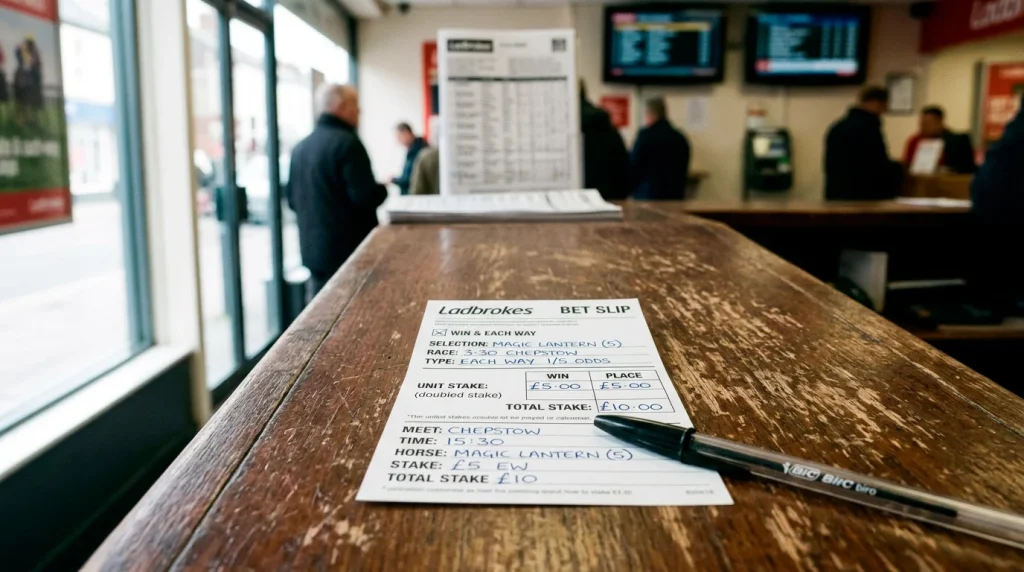
Each-Way Bets in UK Racing: Double Stake Payout Mechanics
The first time I wrote out an each-way bet on a paper slip at Doncaster, the man behind the counter asked me three times whether I really meant £10 each-way and not £10 to win. I did mean it. He still double-checked. That confusion has not gone away in the years since — it is the single most misunderstood instruction in a market that, on the latest Gambling Commission numbers, turned over £766.7 million in remote horse racing GGY across April 2024 to March 2025. Each-way is the workhorse of British horse racing betting, and the workhorse is still walking the wrong way for plenty of punters.
The instruction is simple once you see it on paper. An each-way bet is two bets. One half tries to win the race outright. The other half asks only that the horse finishes in the frame — the British turf phrase for the paid places. You stake the same on both halves, which is why a £10 each-way bet costs £20 at the counter. The two halves settle independently. The win leg either lands or vanishes. The place leg either lands or vanishes. They do not depend on each other, and they do not share a stake. Once you have that picture in your head, every other line in this guide makes sense.
Where each-way gets its grip on British racing is the place leg. It is a softer landing for a longshot, a separate return on a horse you fancy but cannot quite back to win outright. That is why an each-way slip in the rails enclosure at Cheltenham is normal and a £20 win-only slip on the same 16/1 outsider feels reckless. It is the same risk, structured differently.
The two halves: win and place
Picture two slips on the counter at once. That is the cleanest way to think about each-way. One slip says “£10 to win”. The other slip says “£10 to place”. You hand them in together, and the operator settles them together, but they are not joined at the hip.
The win leg pays the full advertised price if your horse finishes first, full stop. Nothing else triggers it. If your 10/1 shot wins, the win leg returns £100 in profit plus your £10 stake — and that part of the bet behaves like any straight win bet you have ever placed.
The place leg is the half people get wrong. It does not pay the same price. It pays a fraction of the win odds — most commonly one-quarter or one-fifth of the advertised price — and only fires if the horse finishes inside the paid places. The rulebook on which fields pay which fraction is set by the UK industry standard, summarised plainly in operator help centres that publish each-way rules. In a handicap of 16 or more runners, for instance, the standard is one quarter the odds for the first four places, which is the formulation bet365’s help centre publishes as the operator-side rulebook. In a non-handicap of eight or more runners, it tightens to one fifth the odds, first three places.
The key word in all of this is independent. Plenty of new punters assume the place part only pays if the win part fails. That is wrong. If your horse wins, both legs of an each-way bet settle as winners. The win leg pays full odds; the place leg pays its fraction. You collect on both. If your horse finishes second, third or wherever the paid places end, only the place leg settles as a winner — and that is the case the slip was really built for.
Why UK racing uses each-way more than any other market
I have asked traders at three different UK operators why each-way is so much more dominant in horse racing than in, say, football. The answer is always some version of the same thing: nothing else has the field shape. Horse racing is one of the few sports where a single race routinely has 12, 16, 20 or even 40 starters. That makes finishing position a serious betting object in its own right, not a footnote. When 65.6% of UK horse racing turnover already happens online, as the latest Gambling Commission citation makes clear, you can see why the format hard-coded itself into every UK racing slip on every mobile app.
There is a longer story underneath that, and it is the one the European Commission acknowledged in its 2017 state-aid clearance of the Levy reforms. The Commission’s language is striking — they wrote that “in the UK, racing and betting have a unique interdependency that goes back over 200 years. A day at the races includes, for most participants, betting on horse races as well.” Each-way is the format that grew up in that interdependency. It is older than the credit card, older than the telephone bet, older than the betting shop counter most of us remember from the 1980s. It survived because it does a job no other bet type does.
That job is risk packaging. An each-way bet hands the recreational punter a softer version of the same opinion. If you fancy a 14/1 outsider in a 20-runner handicap at Ascot, win-only is brave. Each-way says: I want a payday if she wins, and I want a smaller payday if she finishes in the frame. Same horse, same conviction, different envelope.
When the place part actually pays
This is the section where readers usually slow down. The place part pays when your horse finishes inside the paid places — and the number of paid places depends entirely on the field and the race type. In a 5-to-7 runner race, you get two places at one quarter the odds. In a non-handicap of eight or more runners, you get three places at one fifth. Move to a handicap of 12 to 15 runners and it is three places at one quarter. From 16 runners up in a handicap, it is four places at one quarter. In fields under five runners, the place part does not exist at all — the bet collapses to a win-only.
I have watched punters at Wetherby check their slip after a fifth-placed finish, convinced they were owed something, and find that the race only paid three. The number of paid places is on the slip when you place the bet. Operators do not always make it obvious, and the rulebook above is the one applied in the absence of a promotion. When a bookmaker advertises “five places” or “six places” on a major handicap, that is a temporary lift above the standard — typically for a marquee Saturday handicap or a festival race — and the slip will say so. The default is the one to memorise. The promotion is the exception.
There is one bit of footwork that catches more punters than the rest combined. If your horse finishes in a dead heat for the last paid place — say two horses cross the line locked together in fourth, in a race that pays four — your place stake is split. Half the place leg pays out; the other half is lost. The win leg, if the horse won, is not affected. Dead heats are rare, but every each-way punter eventually meets one.
A worked £5 each-way example
Take a 10/1 shot in a 16-runner handicap. You bet £5 each-way. Total outlay at the counter: £10, because £5 goes on the win leg and £5 goes on the place leg.
The win leg’s job is straightforward. If the horse wins, you collect £5 × 10 = £50 profit on the win, plus your £5 stake returned, for £55 from that leg.
The place leg is the one that needs care. In a 16-runner handicap, the standard is four places at one quarter the odds. One quarter of 10/1 is 2.5/1. Apply that to a £5 place stake and you get £5 × 2.5 = £12.50 profit on the place, plus your £5 stake returned, for £17.50 from that leg.
If the horse wins, both legs pay: £55 + £17.50 = £72.50 total return on a £10 outlay. If the horse finishes second, third or fourth, only the place leg pays — you walk away with £17.50. If the horse finishes fifth or lower, the slip is dead. That £10 stake worked harder than a £10 win-only bet would have, but it also cost you more upfront. Whether the trade is worth taking depends on the horse’s actual chance of finishing in the frame versus the price you got — and that is the whole subject of each-way value, which I will revisit elsewhere. For the maths in calculator form, with all the inputs broken out line by line, the each-way calculator walkthrough covers it. The example above is the calculator’s logic written out by hand.
What does the place part pay if my horse wins?
The place part still pays. Both legs of an each-way bet settle independently, so if your horse wins, the win leg pays full odds and the place leg pays its fraction. You collect on both.
Is each-way the same as backing two horses?
No. An each-way bet is two bets on the same horse — one for the win, one for a finish inside the paid places. It is not coverage across two runners.
Do I have to bet the same on each part?
Yes. The win and place stakes on a standard each-way bet are equal, which is why a £5 each-way bet costs £10 in total. Operators will not accept unequal stakes on a single each-way slip.
Articles
Created by the "Racing Place Betting" editorial team.
