
Laying to Place on Betfair Exchange: Commercial Risk Metrics
 Available in US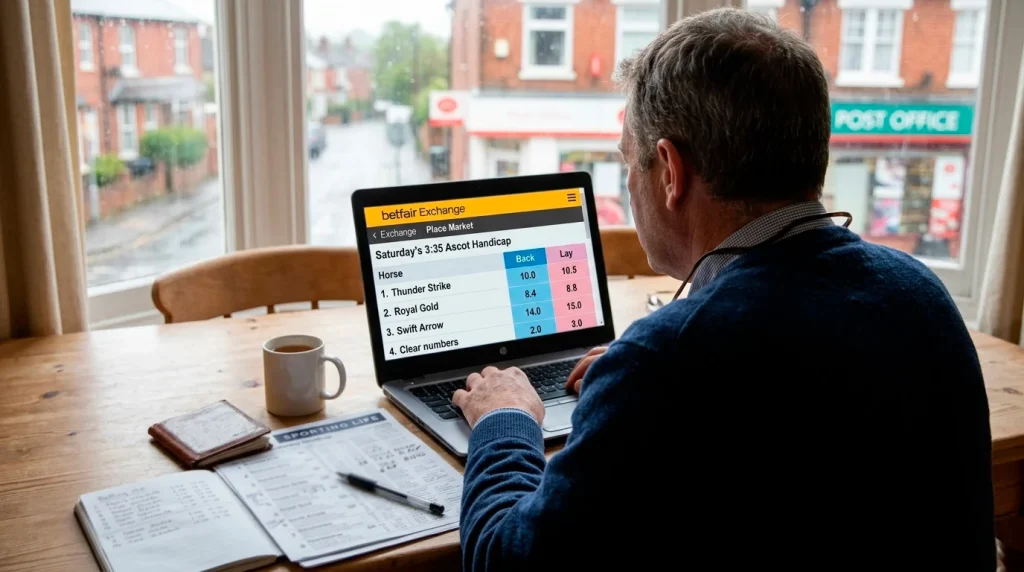
The first time I tried to lay a horse to place, I lost my nerve halfway through and ducked out of the order. The price was right, the field looked vulnerable to the favourite missing the frame, and I still could not bring myself to click confirm. Laying — taking the position of the bookmaker, accepting other punters’ bets in exchange for paying out if they win — is psychologically the opposite of normal punting, and it takes practice to internalise. It also reveals something the standard back-only punter rarely sees: the bookmaker’s side of the slip, with all its liability calculations and risk asymmetries. UK racing turnover has been under pressure in recent years — Richard Wayman from the British Horseracing Authority noted that total turnover up to the end of Q3 in 2025 ran 4.2 per cent below the same nine months in 2024 and 12.8 per cent below 2023 — and a portion of that displaced turnover has migrated to the exchange, where laying is a routine part of the trading day.
This piece is for the punter who has placed back bets on Betfair before, understands the basic exchange mechanic, and wants to try laying in the place market specifically. Win-market laying is a more established discipline. Place-market laying has its own structural quirks that make it both more accessible and more deceptive than win-market laying for a beginner.
How Laying to Place Works
I keep a diagram on paper for the friends who ask me to explain laying. Imagine a horse offered at decimal odds of 3.0 in the place market — three pounds returned for every pound staked if it places, with one pound of profit going to the backer. To lay this horse, you are offering to be the bookmaker. You will pay out the profit if the horse places. You will collect the stake if it does not. Your maximum liability — the worst case if the horse places — is the stake the backer commits multiplied by (odds minus one).
If you lay one pound at 3.0, the backer can match against your offer with one pound. If the horse places, you pay them two pounds of profit and they keep their original stake. If the horse fails to place, you collect their one-pound stake. Your liability on this single lay is two pounds. Your reward, if the horse misses the frame, is one pound. That is the inverse of back betting: the backer risks one to make two, you risk two to make one.
The place market is a unique animal here because it pays multiple positions. On a sixteen-runner handicap paying four places, the place market settles on four distinct horses — not one. A horse you lay can finish second, third or fourth and still pay out from your liability. That makes place laying riskier per pound of stake than win laying, because the universe of outcomes in which you lose is much wider than the win market’s single-winner universe.
Liability and Stake Sizing — The Discipline Most Beginners Skip
I had a friend who decided one Saturday that he was going to lay every short-priced favourite to place across the card and pocket the consistent unders. He lasted three races. The fourth horse placed, his entire weekly profit went sideways in twenty seconds, and he was back to back-only punting by Sunday morning. The lesson is that laying at short odds carries proportionally larger liability per pound of stake than backing at any price, and the place market amplifies this because the favourites do place far more often than they win.
The standard discipline for sizing a lay bet is to compute the worst-case liability before placing the order, never after. Laying ten pounds at 2.0 on the place market carries a ten-pound liability. Laying ten pounds at 3.0 carries a twenty-pound liability. Laying ten pounds at 5.0 carries forty pounds of liability — four times the matched stake. The exchange interface displays this calculation in the slip, but the discipline is mental: never lay an amount whose worst-case liability exceeds the loss you can take comfortably on the bet.
For a beginner, my recommendation is to start with lay bets where the liability is under twenty pounds total — that is, very small matched stakes at short prices. The reason is not the absolute number but the psychology. The first time a horse you have laid actually places, the liability call hits, and the experience is different from a losing back bet because the loss is larger than the stake you committed. Building comfort with that asymmetry takes practice that is best done at small scale.
Where Liquidity Supports Laying
The exchange place market does not work everywhere. Liquidity — the volume of money flowing through both back and lay sides of the market — determines whether your lay order can be matched at the price you want and whether the market is deep enough to absorb your stake without moving the price against you. The 2025 Cheltenham Festival saw 68.8 million bets struck across the four days, with daily active customers up between 178 and 189 per cent on baseline, and the place markets at Cheltenham were extremely deep — every Cheltenham race that year sat in the top thirty-one most-bet UK races of the season, with all twenty-eight festival races qualifying.
That kind of liquidity supports place laying at meaningful stake. A Saturday at the Cheltenham Festival, with major handicaps drawing seven-figure matched volumes on both win and place markets, gives a lay punter the order book depth to lay short-priced favourites without moving the market against themselves. A Wednesday afternoon at a smaller course offers very different liquidity. The same lay order that would match smoothly at Cheltenham may sit unmatched at Lingfield, or may match only at a worse price as the order book thins.
The practical heuristic I use is to check the matched volume on the place market before placing any lay order. If the total matched volume is under twenty thousand pounds at the time you are looking, the market is too thin for laying with confidence. If it is over fifty thousand and the next-best price either side of yours is within a tick or two, the market is liquid enough to operate in. For the deeper structural understanding of how exchange place markets behave through the trading day and around the off, the detailed walkthrough of Betfair exchange place markets covers the matched-volume rhythms and the order-book dynamics in depth.
The Basic Risk Maths of a Place Lay
The single most useful number for a beginner to compute is the break-even probability of a lay bet. If you lay a horse at decimal odds of 3.0, you collect the matched stake if it does not place and pay (odds minus one) times the stake if it does. Break-even comes when the probability of the horse placing matches one divided by the lay odds. At 3.0, that break-even is 33.3 per cent. The horse needs to have less than a one-in-three chance of placing for the lay to be positive expected value before commission.
The trap for beginners is that place probabilities in deep fields are higher than they intuitively feel. A 4/1 second favourite in a sixteen-runner handicap paying four places — applying the 2025 average Premier Flat field size of 11.02 runners as a reference, though large handicaps run deeper — has an implied place probability comfortably above 40 per cent and often above 50 per cent. Laying that horse at place market odds of 2.0 implies a break-even of 50 per cent, which is right on the edge of what the horse’s actual probability suggests. The market is rarely badly mispriced. The edge a lay punter looks for is small, and it usually has to be paid for with patient selection rather than aggressive volume.
Commission applies to net winnings on the exchange, which means a winning lay — the horse misses the frame — has five per cent shaved off the matched stake at the prevailing commission rate. Over a sustained period, that compounds materially against the lay punter’s edge. Sustainable place laying is about identifying spots where the market has mispriced the place probability sufficiently to overcome both the structural drag of commission and the variance of single-race outcomes.
Working a First Lay Through End to End
I will close with the exact framework I would walk a friend through on their first lay. Pick a Saturday with strong liquidity — a Premier Fixture handicap with sixteen-plus runners, matched volume above fifty thousand pounds on the place market with twenty minutes to the off. Look at the place market and identify a horse priced shorter than its win-form would justify, often the short-priced favourite that has drawn weight from sentimental backing rather than form analysis. Compute the break-even probability implied by the lay odds. Compare it to your own honest assessment of the horse’s place probability based on form, going, course suitability and trainer record. If your assessment is meaningfully lower than the implied probability, lay a small stake — five to ten pounds matched — and watch the bet through. Record the result. Repeat over a sequence of bets before drawing any conclusion about whether your selection process has an edge. Place laying is not a quick discipline. It rewards small, patient, well-recorded action far more than it rewards bold single moves.
What is the minimum field size in which laying to place is sensible?
Place markets settle on multiple paid positions, so smaller fields concentrate the place probability on fewer horses and make laying riskier. Sixteen-plus runner handicaps with four paid places provide the most workable structure, because the implied probability per horse is more dispersed and pricing inefficiencies are more visible. Below twelve runners, laying the place becomes structurally harder to make pay.
Can I lay every horse to place and create a "book"?
Laying every horse to place produces guaranteed losses on the paid positions, equivalent to running a negative-margin pari-mutuel pool. The exchange place market overround typically runs at 95 to 102 per cent across all runners after commission, which means trying to lay the whole field produces a slow steady loss rather than a profit. Selective laying on specific horses with mispriced place probabilities is the only viable approach.
Are exchange commission rates higher on place markets?
Commission applies uniformly across win and place markets on Betfair at the same percentage rate. The structural difference between the markets is not the commission rate but the matched volume and the price-formation dynamics — place markets tend to carry tighter overrounds than win markets on liquid races, which means commission is a relatively larger share of net edge on the place side.
Articles
Prepared by the Racing Place Betting editorial staff.
