
Cheltenham Festival Extra Places: High-EV Handicap Payouts
 Available in US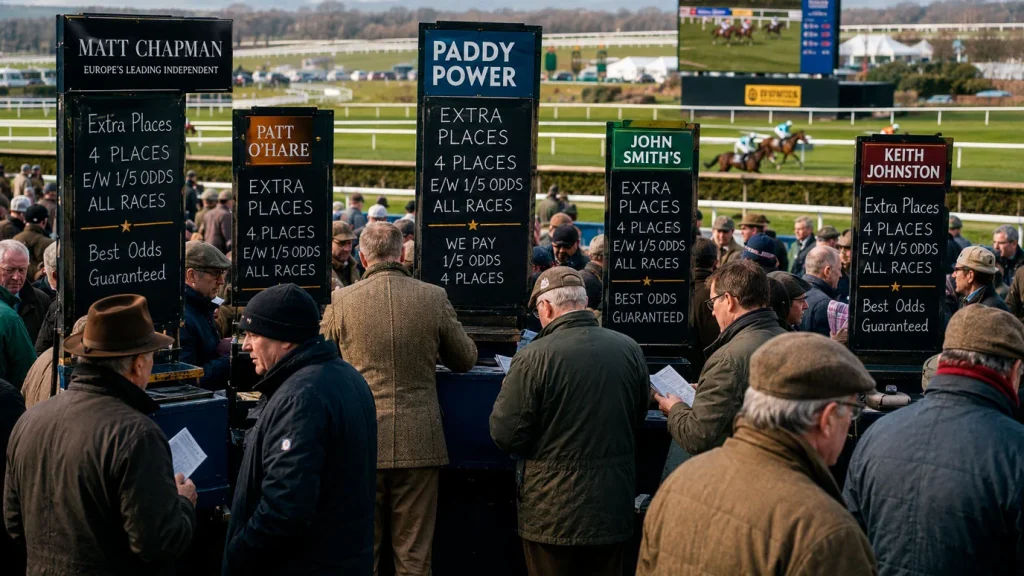
Cheltenham Festival Extra Places: High-EV Handicap Payouts
I have been to Cheltenham every March since I started writing about each-way markets. The Festival has the most predictable behavioural surge in the UK betting calendar — first-time deposits surged by 310-417% during Cheltenham 2025 compared with a neutral week, according to Optimove Insights, and Gold Cup day average stake per punter ran 109-133% above baseline. That surge is what operators are competing for when they redesign their place-terms menu for the four days. Every major UK firm rebuilds its each-way pricing around the Festival; nothing else in the year — not Royal Ascot, not the Grand National, not the Derby — produces this combination of high volume, high media coverage and high field competitiveness across a sustained run of races.
The Optimove data underneath the surge is the part most punters never see. The Festival drew 68.8 million individual bets across the four days under their tracking. Daily active player counts ran 178-189% above baseline. This is the marketing environment in which extra-places promotions live. Operators do not announce six paid places on the Ultima Handicap for love. They announce it because, on Festival week, every increment of place generosity buys measurable acquisition. All 28 races of the 2025 Cheltenham Festival ranked in the top 31 most-bet-on horse races of the year in the UK; the betting volume on the Festival alone is roughly the same magnitude as the betting volume on every other Cheltenham meeting of the year combined.
What this means for the each-way bettor is that Festival place terms are structurally more generous than equivalent fields would be at any other meeting. The question is which races attract the generosity, which do not, and why.
Which Cheltenham races attract extra places
The Festival’s 28 races split into two structural categories for extra-places purposes: championship races and handicaps. Championship races — Champion Hurdle, Queen Mother Champion Chase, Stayers’ Hurdle, Gold Cup, the various Grade 1 novice events — rarely attract extra paid places. They are non-handicap races, often with small competitive fields of 8-14 runners. The standard rulebook applies: three places at one fifth the odds for an eight-or-more-runner non-handicap. Operators sometimes push to four places at one fifth on the Champion Hurdle and Gold Cup as a Festival-specific flourish, but the move is modest.
Handicaps are the different story. The Festival’s handicaps are the marketing magnet for extra-places promotions. The Ultima Handicap Chase on day one, the Coral Cup on day two, the Plate on day three, the County Hurdle and Grand Annual sprinkled across the four days — these are the races that routinely attract five, six and even seven paid places. The Ultima has carried six paid places at one fifth as a standing operator offer in recent years; the Coral Cup, with its typical 24-28 declared runners, has been offered at six places at one quarter by some operators and seven places at one fifth by others. The dispersal across operators is the punter’s edge: read the menu before settling.
The 2025 Festival saw 68.8 million bets in total across the four days. Operator-level data suggests that 60-65% of that volume flowed through the handicaps rather than the championship races, despite the handicaps accounting for fewer than half the total races. Casual punters are drawn to handicaps because the prices are bigger and the each-way payouts are more frequent. Operators are drawn to the handicaps because that is where casual money lives. The pricing competition follows the money. By the time the Festival opens on Tuesday, the major operators have published their extra-places menus, and the cheapest place terms in handicaps are usually 25-50% more generous than the standard rulebook would suggest.
Handicaps vs graded races at the festival
The structural difference between Festival handicaps and Festival graded races is the field shape. A Festival Grade 1 novice hurdle might land with 10-14 runners, mostly priced 6/4 to 14/1, with the field heavily concentrated around the favourite. A Festival handicap of similar Grade — the Coral Cup is a Grade 3 Premier Handicap — lands with 22-28 runners, mostly priced 10/1 to 50/1, with the field dispersed across a much wider price range.
The bookmaker’s overround on a 12-runner Grade 1 with a 6/4 favourite is concentrated at the short end of the market. The place market is structurally tight; paying an extra place on a 6/4 favourite would cost the operator real money. The bookmaker’s overround on a 25-runner Grade 3 handicap with a 9/1 favourite is spread across a deep tail. Paying an extra place on a 25/1 runner costs the operator less in expectation, because most 25/1 runners do not finish in the frame anyway. The marketing logic is clear: extra places are cheap to offer on long-priced runners in deep fields and expensive on short-priced runners in tight fields. The handicaps fit the cheap profile; the graded races fit the expensive profile.
The cleanest illustration is the Mares’ Hurdle vs the County Hurdle. The Mares’ Hurdle is a Grade 1 race with typical fields of 12-16 runners, heavily concentrated around a short-priced favourite. Operators rarely offer extra places on it. The County Hurdle on the same day is a Premier Handicap with 22-28 runners, deep distribution across the field. Operators routinely offer five, six, sometimes seven paid places on it. Same Festival, same day, opposite each-way menu. Royal Ascot has a similar structural pattern, with Group races tighter than handicaps; for the Ascot-specific breakdown, the Royal Ascot each-way breakdown covers it across the meeting’s full programme.
Bettor behaviour during the four days
The Festival’s betting surge is the single most studied behavioural episode in UK racing. Optimove’s tracking across major UK bookmaker platforms during the 2025 Festival recorded 68.8 million individual bets across the four days, with daily active player counts running 178-189% above baseline. The first-time-deposit surge — 310-417% above baseline — is the metric that explains the operators’ extra-places strategy more clearly than anything else. Those are punters being acquired for the first time, and the acquisition is concentrated on the marquee handicaps.
Gold Cup day specifically saw average stake per punter run 109-133% above baseline. That is partly a function of the Gold Cup itself being a bigger-stakes race in the casual punter’s mental model, and partly a function of the multi-race ticket structures — Lucky 15s, accumulators, Placepots — that experienced punters layer across the day. Each-way bets are concentrated in the handicaps on Gold Cup day; the Foxhunters and the Cathcart and the County Hurdle traditionally take more each-way volume than the Gold Cup itself, despite the Gold Cup being the headline race.
The behavioural pattern across the four days follows the volume. Tuesday’s opening day, with the Champion Hurdle and the Ultima Handicap, sees acquisition spike sharply as first-time depositors arrive. By Friday, those new punters are placing larger bets per slip, often into multiples. The operators’ extra-places menus track this behaviour: more generous terms on opening-day handicaps to acquire, slightly tighter terms on closing-day handicaps where the existing punter base is already engaged. This is not advertised. It is visible only in operator-by-operator menu comparison across the four days.
What this means for the punter is that the marquee handicaps on opening day are usually the most generously priced from a place-terms perspective. The Ultima in particular has tended to be one of the more aggressively promoted races on each-way generosity, because acquisition cost is justified by the four days of subsequent activity from each new depositor.
Reading the extra-places menu without distractions
The Festival’s extra-places menu is published by operators in three places: their main race-card page for each Festival race, their “Cheltenham offers” hub page, and the printed slip terms that appear when you tap into a specific market. The three should agree. When they do not, the slip terms — the version you see at the moment of bet placement — are the binding ones. Read the slip terms before committing.
The menu format is usually a single line: “5 places paid at 1/5 the odds” or “6 places paid at 1/4 the odds”. The fraction is the critical bit; the place count without the fraction is meaningless. A standing offer of six places at 1/4 the odds is structurally more generous than a promotional offer of seven places at 1/5 for any horse priced 8/1 or shorter, and even for many longer-priced runners depending on field depth.
The cleanest comparison method I use is this: for the horse and price you intend to back, run the place leg arithmetic at each operator’s quoted terms. Take a 14/1 each-way slip with a £10 stake. At six places, 1/4: place leg pays 14/4 = 3.5/1, returning £45 on a £10 place stake. At seven places, 1/5: place leg pays 14/5 = 2.8/1, returning £38 on a £10 place stake. The six-place 1/4 is structurally more generous in cash terms, by £7, provided the horse finishes inside the top six rather than the top seven. The probability of a 14/1 horse finishing exactly seventh and not in the top six is small. For most horses at most prices, six places at 1/4 outperforms seven places at 1/5. The marketing wants you to count places. The maths wants you to multiply by the fraction. Multiply first.
Do extra places at Cheltenham apply only on the day of the race?
Most extra-places promotions at Cheltenham apply from the day before the race or earlier in the week, but the precise window depends on the operator. Slips placed inside the promotional window inherit the extra places automatically; slips placed earlier ante-post typically inherit the promotion when it is announced.
Which festival handicaps usually attract the most extra places?
The Coral Cup, Ultima Handicap Chase, County Hurdle, Grand Annual and Plate Handicap are the Festival handicaps most consistently offered with five to seven paid places. Field sizes of 22 to 28 runners and the typical price distribution drive the operator"s willingness to offer more generous place terms.
Do exchanges adjust their place markets to mirror festival extras?
No. Exchange place markets are built from the standard each-way rulebook for field size and race type. They do not mirror operator-specific extra-places promotions, which means a fixed-odds each-way at the promoted terms can pay more places than the same horse in the exchange place market.
Articles
Created by the "Racing Place Betting" editorial team.
