
Tote Placepot Betting: Multi-Race Pool Value and Dividends
 Available in US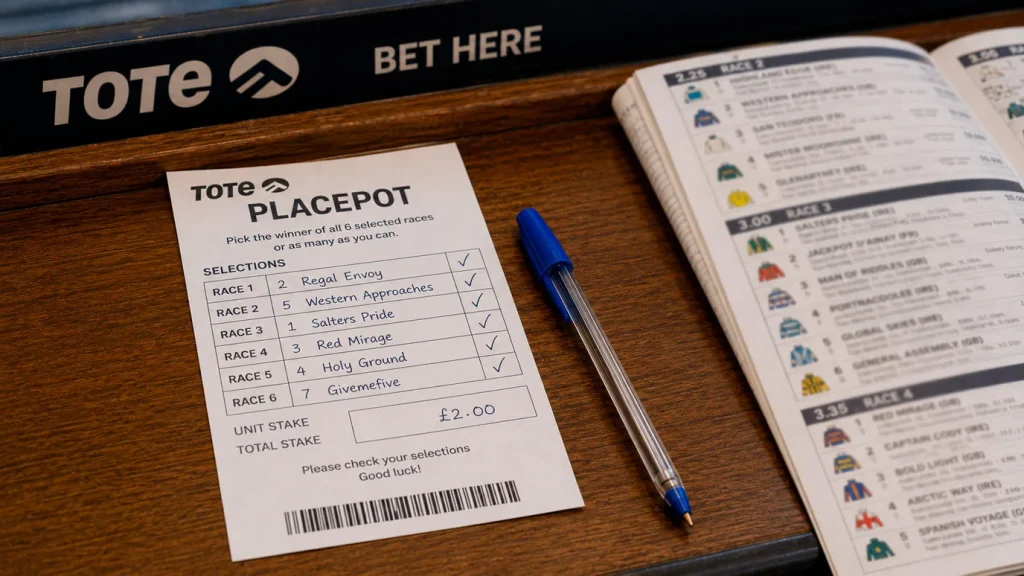
Tote Placepot Betting: Multi-Race Pool Mechanics and Takeout Rates
The Placepot is the closest thing UK racing has to a national lottery for racegoers. Pick a horse to finish in the frame in each of the first six races on the card. Six legs, one ticket, one pool. If your horses all place, you share the pool with everyone else who picked the same combination. Nigel Roddis, the Managing Director of Britbet Racing LLP, captured the cultural pull of the product when he reflected after Cheltenham 2024: “It was a very positive week for Britbet and I hope that racegoers enjoyed themselves. We had some notable wins through the week, the most high profile being a £55,000 return from a £5 Placepot bet.”
Those headline dividends are real, and they are how the Placepot has earned its reputation. Geegeez analysis tracks an average Placepot dividend across UK meetings of approximately £400 to £500 for a £1 unit stake, with the record Cheltenham Placepot in 2019 returning £182,567 from a £2 stake. That mix of routine three-figure paydays and occasional five- or six-figure jackpots is the Placepot’s marketing proposition, and it differs structurally from anything fixed-odds bookmakers offer.
The product also differs from each-way in two important ways. First, you do not know the price you are taking when you place the bet — the dividend depends on how many other punters share the winning combination. Second, the takeout is much higher. The Tote takes 27% from the Placepot pool before dividends are calculated, while a typical fixed-odds book sits at 110-115%. Whether the Placepot is good value or bad value compared to fixed-odds each-way depends on the racing, the field shapes and the pool’s distribution. It is rarely a simple comparison.
How the six legs work
A Placepot ticket asks you to pick a horse to finish in the frame in each of the first six races on the card. “Finish in the frame” follows the same rulebook the each-way market uses: in handicaps of 16+ runners, the top four; in handicaps of 12-15 runners, the top three; in handicaps of 8-11 runners and non-handicaps of 8+ runners, the top three; in 5-7 runner fields, the top two; in fields under five runners, win-only territory and the race may be voided from the Placepot.
You can pick one horse per leg or multiple horses per leg. Picking two horses in a leg doubles the cost of the ticket; picking three triples it; the cost compounds across the six legs. A single-line Placepot — one horse per leg, six legs — costs the minimum stake (typically 50p or £1). A 2-1-1-2-1-2 ticket — two horses in legs 1, 4 and 6, one in legs 2, 3 and 5 — costs 2×1×1×2×1×2 = 8 units. The combinations are called “perms” or “lines”; each line is a separate ticket inside the pool.
Once placed, the ticket runs through the six races automatically. After each race, the Tote applies the standard place-terms rule to the result. Your horse either qualifies (finished in the frame) or your ticket is dead in that line. After leg six, any lines still alive share the dividend.
The number of paid places per leg follows the standard rulebook, not any operator promotion. The Placepot does not apply extra-places promotions. So a Wokingham at Royal Ascot, which might pay seven places at one fifth on a fixed-odds each-way menu, pays only four places in the Placepot (under the 16+ runner handicap rule). The Tote’s place-terms rule is structurally tighter than the extra-places-promoted fixed-odds market on the same race.
Pool, takeout and dividends
The Placepot pool is the total amount staked by all punters across all lines. The pool builds throughout the betting window, which typically opens around 8am UK time on the morning of the meeting and closes at the off of the first race. By the time the Tote takes its commission, the pool can be anywhere from a few thousand pounds at a quiet midweek Core Fixture to millions at the bigger Saturday meetings and the festivals.
The Tote takes a 27% commission from the Placepot pool before dividends are calculated, with the standard Win pool takeout in the 16-26% range depending on bet type. That 27% is the headline takeout and it is higher than any major fixed-odds operator’s overround on a single race place market. The reason the Placepot can still produce competitive dividends is that the pool is split among a small number of surviving lines, and on a tough card the dividend per surviving line can be very large.
The dividend is calculated as (pool after takeout) ÷ (number of winning lines) ÷ (unit stake). On a £100,000 pool with 70% surviving the takeout (£70,000) and 200 winning lines at £1 unit stake, the dividend would be £350 per £1 unit. On the same pool with only 5 winning lines, the dividend would be £14,000 per £1 unit. The variance in dividends comes almost entirely from the number of surviving lines, not from the size of the pool.
That variance is the reason the Placepot’s geometric-mean dividend sits in the £400-£500 range despite the pool itself often being orders of magnitude larger. Most cards produce a few hundred surviving lines and a few-hundred-pounds dividend per unit; occasional brutal cards produce only a handful of surviving lines and the dividend balloons into the tens of thousands.
Lines, perms and the cost of coverage
The decision every Placepot player faces is how widely to cover. A single-line ticket — one horse per leg — costs the minimum unit stake. A six-line ticket spreads across multiple horses per leg. The Tote allows perms up to enormous numbers, but the cost compounds geometrically: covering two horses in every leg costs 2^6 = 64 lines; covering three horses in every leg costs 3^6 = 729 lines.
The mental model that helps here is the one experienced pool players use. The Placepot is a probability product. If you have a 50% chance of picking the correct frame finisher in each leg, your single-line probability of winning is 0.5^6 = 1.5625%. If you cover two horses per leg and improve your per-leg accuracy to 75%, your six-leg probability rises to 0.75^6 = 17.8% — but you have paid 64 times the unit stake to get there. Whether the trade is worth taking depends on the dividend’s relationship to the cost. On a deep card with a £500 dividend, a 64-line ticket at £1 unit stake costs £64 and pays £500 if you hit. That is a 7.8x payout on a roughly 17.8% probability, which is a fair to mildly positive trade in expectation, depending on your edge in each leg.
The risk is that “improved per-leg accuracy from 50% to 75% by adding a horse” is harder than it looks. Adding a horse to a leg shores up the obvious favourite-second-favourite cover, but it can also dilute the line’s value if the additional horse rarely places. The mathematics rewards informed selectivity over blanket coverage, which is why experienced pool players spend more time on leg-by-leg analysis than on perm structuring.
Where the Placepot pays best
Three card profiles produce the best Placepot dividends in my experience. The first is a tough card with several long-priced winners — a Pontefract Tuesday or a Newton Abbot Thursday where favourites under-perform and the surviving lines collapse to single digits. These produce occasional five-figure dividends per unit stake.
The second is festival cards where the pool is massive but the racing is genuinely competitive. The 2019 record Cheltenham Placepot of £182,567 from a £2 stake came from this combination — a huge pool, six tough legs of Festival racing, and a small number of surviving lines splitting the dividend. Festival Placepots are dramatically larger pools than midweek Placepots, with average dividends typically in the £600 to £1,200 range, and outliers running into the five and six figures.
The third is meetings where the field shapes work in the Placepot’s favour. A card with several 8-11 runner non-handicaps (paying only three places at the Tote’s standard rule) is structurally harder than a card with several 16+ runner handicaps (paying four places). Harder cards collapse more lines, produce larger dividends per survivor, and reward selective Placepot players more than friendly cards do.
The Quadpot — a four-leg version of the same product running on legs three to six — exists as the cheaper alternative for punters who arrive late or want to skip the first two legs of a card. For the structural differences between the four-leg and six-leg pool products, the Quadpot betting breakdown walks through the comparison. The Quadpot’s dividends are smaller in absolute terms but the per-line variance is lower, which suits a particular kind of pool player.
Why does the Tote take 27% of the Placepot pool?
The 27% takeout reflects the Tote"s operating costs, prize-money contribution and the commercial economics of pool betting in the UK. The figure has been broadly stable since the Tote restructured in the early 2010s and is published in the Tote"s pool rules.
Can my Placepot still win if one leg has fewer than 5 runners?
If a Placepot leg has fewer than 5 runners and no place market is generated, the Tote typically treats that leg as a banker for all live tickets — any horse selected in that leg qualifies. The structural treatment of small-field legs is set out in the Tote"s published rules and may vary slightly across meetings.
Is there a minimum Placepot stake?
Yes. The minimum unit stake is typically 50p, with some meetings setting it at £1. The minimum stake applies per line, so a multi-line ticket multiplies the minimum across the number of lines.
Articles
Created by the "Racing Place Betting" editorial team.
