
Quadpot Betting Rules: Multi-Race Pool Dividend Maximization
 Available in US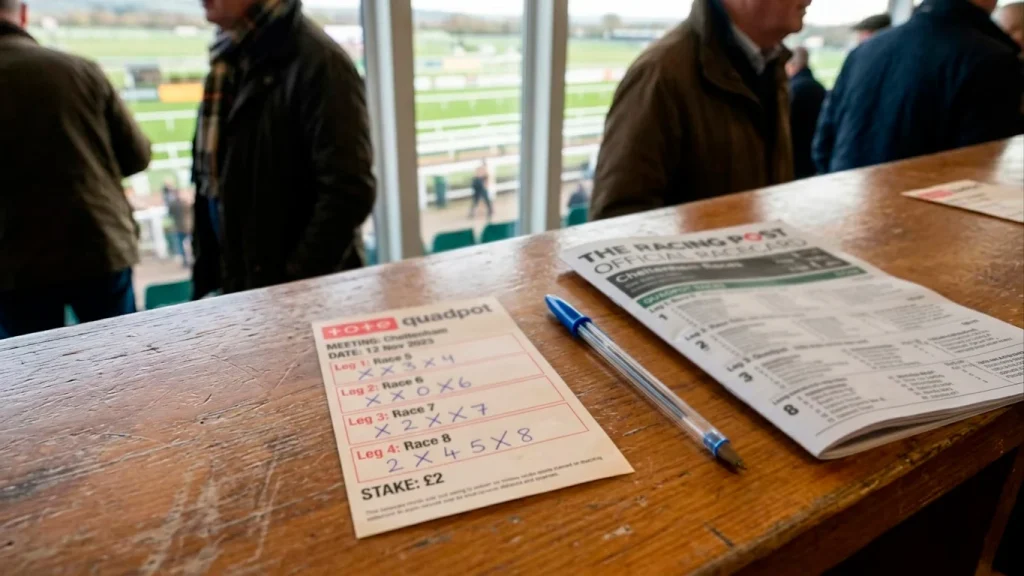
Quadpot Betting Rules: Alternative Multi-Race Pool Line Selections
The Quadpot is the Tote’s second-string pool product, and in a perfect world it would be a better-known one. It runs on legs three through six of a UK race card — the same Placepot legs minus the first two. The structural logic is straightforward: many UK racegoers turn up at the track between the second and third races, particularly at the bigger Saturday meetings, and would otherwise watch the Placepot pool close while standing in the bar. The Quadpot’s window is open until the off of leg three (which is leg one of the Quadpot itself), letting late arrivals into a four-leg pool product that captures most of the day’s racing.
The Tote takes a 27% commission from the Placepot pool before dividends are calculated, with the standard Win pool takeout in the 16-26% range depending on bet type. The Quadpot sits inside the higher of those bands — typically the same 27% as the Placepot, applied to a smaller pool with a smaller field of legs. The result is a product with lower headline dividends than the Placepot but lower per-line variance, which suits a different kind of pool player.
What the Quadpot offers, structurally, is reduced variance for a smaller cover cost. Four legs instead of six means fewer probability multiplications, more surviving lines per pool, and a tighter distribution of dividends. The famously dramatic Placepot dividends — six-figure outliers like the 2019 Cheltenham £182,567 result — do not happen in Quadpots. But a £30 to £80 dividend on a midweek meeting Quadpot, against the Placepot’s average of £400-£500, is a very different commercial product. Some pool players prefer the steadier earner; some prefer the lottery.
Four legs, not six: what changes
The mechanical change between Placepot and Quadpot is the leg count. Four legs instead of six. The qualification rule for each leg is identical: the chosen horse must finish in the frame under the same place-terms rulebook that governs each-way bets. In handicaps of 16+ runners, the top four; in handicaps of 12-15 runners, three; in 8+ runner non-handicaps and 8-11 runner handicaps, three; in 5-7 runner fields, two; below five runners, the leg may be voided.
What changes mathematically is the probability product. A Placepot’s six-leg single-line probability, assuming 50% per leg, is 0.5^6 = 1.5625%. A Quadpot’s four-leg single-line probability at the same per-leg rate is 0.5^4 = 6.25%. The single-line Quadpot is four times more likely to hit than the single-line Placepot, all else equal. That difference shapes the dividend structure.
The pool itself is smaller. A typical midweek Quadpot pool runs in the £2,000 to £15,000 range, compared with £5,000 to £50,000 for the same meeting’s Placepot. Festival Quadpot pools are larger — Cheltenham Festival Quadpots can reach £100,000-plus — but the relative size to the Placepot stays roughly consistent: the Quadpot is one-third to one-half the Placepot pool on the same card.
Coverage strategy also changes. Because the probability per line is higher, the value of “perming” a Quadpot is less compelling than perming a Placepot. A single-line Quadpot is genuinely viable for a confident selector; a single-line Placepot is essentially a punt. Most experienced pool players will perm a Placepot heavily and play the Quadpot more selectively, which is the structural reason Quadpot pools tend to have a higher proportion of single-line tickets than Placepot pools.
Dividends and variance
The average Quadpot dividend across UK meetings sits in the £30 to £80 range for a £1 unit stake, compared to the £400 to £500 range for Placepots. The factor-of-six gap between them reflects three things: the smaller pool, the smaller leg count, and the larger number of surviving lines per pool.
The variance distribution is narrower. Most Quadpots dividend within £20 to £150 per unit. Outliers above £500 are uncommon; outliers above £1,000 are rare. The few-thousand-pound Quadpot dividends I have seen historically have come from cards where multiple favourites failed to place — typically National Hunt midweek meetings on heavy ground where form lines collapse and frame-finish outcomes are genuinely hard to call.
The structural reason the variance is narrower is the leg count. Each additional leg in a pool product compounds the probability product geometrically. Six legs produces more “near-miss” lines (five-of-six tickets that get knocked out at the last leg) and a smaller pool of survivors. Four legs produces a wider survivor pool relative to the total. The dividend per survivor is correspondingly smaller and more stable.
For punters who care about hit-rate over headline returns, the Quadpot is structurally the better product. Hitting one Quadpot in five attempts at an average £50 dividend on £1 stakes produces a roughly break-even return over time. Hitting one Placepot in twenty-five attempts at an average £450 dividend on the same stakes produces a similar break-even return over time. Same long-run economics, different short-run experience. The Quadpot’s frequency makes it less punishing for the casual player, even if its headline dividends never make the racing pages.
Cost comparison vs the Placepot
A like-for-like cost comparison between Placepot and Quadpot is best done on a typical perm structure. Take a 2-1-1-2-1-2 Placepot — two horses in legs one, four and six, one horse in legs two, three and five. That is 2×1×1×2×1×2 = 8 lines, £8 at £1 unit stake.
The same horses in the equivalent Quadpot — which runs on legs three through six, so the Placepot’s legs 3-6 are the Quadpot’s legs 1-4 — would be 1×2×1×2 = 4 lines, £4 at £1 unit stake. Half the cost, because two of the Placepot’s perm legs (legs one and four under that example) reduce or vanish in the Quadpot’s structure.
The probability of hitting is correspondingly different. The Placepot’s 8 lines covering 4-of-6-legs with multiple horses gives roughly a 5-8% chance of winning depending on the per-leg accuracy. The Quadpot’s 4 lines on the same horses across legs 3-6 gives roughly a 15-20% chance of winning, again depending on per-leg accuracy. Both probability ranges are rough — the underlying per-leg accuracy varies meeting to meeting — but the structural relationship holds. The Quadpot trades dividend size for hit frequency at roughly a 4:1 ratio in expected probability and a 1:8 to 1:10 ratio in dividend size.
For the wider context on how the Tote and Britbet pool place market sits alongside fixed-odds each-way, the Tote and Britbet pool place betting overview sets out how the two pool products fit into the broader UK place market and where each suits a particular kind of punter.
When the Quadpot is the better pick
Three circumstances tip me toward Quadpot over Placepot. The first is late arrival. If I miss the first two races on the card — common at the bigger meetings where parking and pre-race logistics eat up the morning — the Placepot window is closed but the Quadpot is still live. The Quadpot is then the only pool product available, and the comparison question does not arise.
The second is confidence level in specific legs. If my conviction is strongest on the back half of the card — the feature race plus the closer — and weakest on the opening two legs, the Quadpot lets me bet only the legs I actually believe in. The Placepot would force me to guess on the opening legs, which dilutes my structural edge. The Quadpot’s four-leg structure is closer to a focused multi-leg perm than a full-card commitment.
The third is bankroll discipline. Pool products compound quickly when you perm aggressively. A £100 stake produces a 100-line Placepot if you perm 2-2-2-2-2-2 (64 lines at £1.56 per line, rounded to about 100 lines at £1 per line if you trim the structure). The same £100 produces a 16-line Quadpot at the same per-leg coverage (2^4 = 16 lines at £6.25 per line). The Quadpot gives you bigger per-line stakes for the same total outlay, which means each surviving line returns a larger absolute amount on the dividend.
What I never do is play the Quadpot as a “safety net” alongside a heavily-permed Placepot on the same selections. The two products dividend from independent pools and the maths is not additive in the way the casual marketing implies. If I am committed to a card, I pick one product and stake into it properly. The Quadpot is the cleaner standalone bet most of the time; the Placepot is the right call only when the card and my confidence support a six-leg structure.
Which legs does the Quadpot start on?
The Quadpot runs on legs three through six of a UK race card, which are typically the four races in the middle and end of the meeting. The betting window stays open until the off of leg three.
Do Quadpot dividends scale with field size?
Indirectly. Larger fields produce more paid places per leg under the Tote rulebook, which means more punters" selections qualify and the surviving line count climbs. That tends to compress dividends. Deeper handicaps with four paid places per leg typically produce smaller Quadpot dividends than tight non-handicap cards with three paid places per leg.
Can I run a Placepot and Quadpot from the same selections?
Yes. The two are independent pool products and accept separate tickets. Some punters perm a Placepot across all six legs and a Quadpot across legs three to six on the same selections, as a hedge structure, though the maths is not strictly additive.
Articles
Prepared by the Racing Place Betting editorial staff.
