
Dead Heats on Each-Way Bets: Payout Reduction Calculations
 Available in US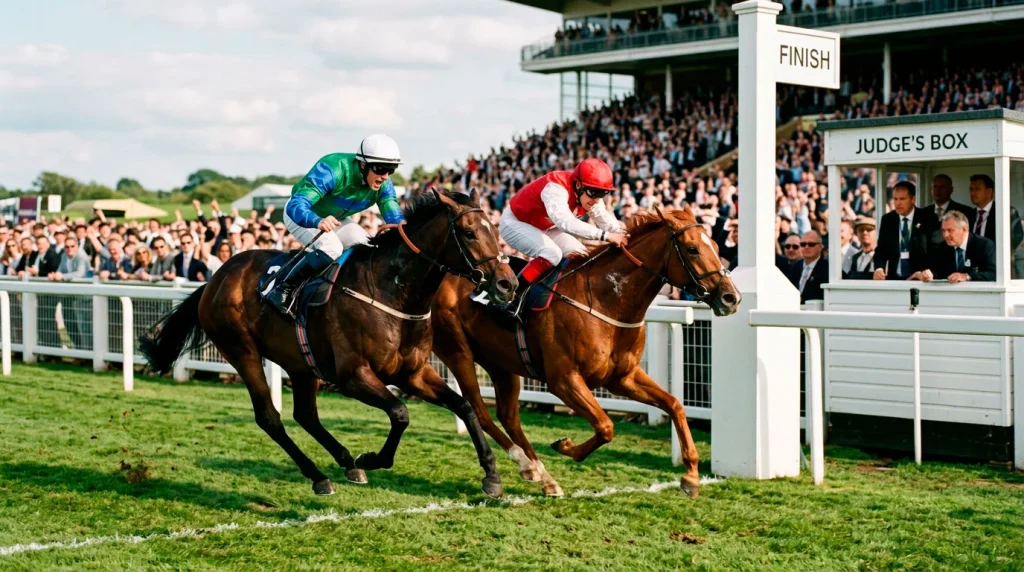
I was at York in August when two horses crossed the line in a photograph so tight that the judge needed several minutes to call the result a dead heat. My phone lit up almost instantly — a friend in the bar wanting to know whether his each-way slip was paid full or half. He had backed one of the two horses each-way at 8/1 in a fourteen-runner handicap, watched it finish in what looked like a clear fourth, and then watched the result print as a dead heat between his horse and another for fourth place. The bookmaker would settle the place portion of his bet at a fraction of the full return. The win portion was untouched. Welcome to the dead heat — one of the least understood adjustments in the each-way book, and one of the easiest to miscalculate when you are sitting in a pub waiting for a settled slip.
Richard Wayman from the British Horseracing Authority put a useful frame around how nuanced result settlement has become across the modern UK racing programme. Racing publishes the result, the bookmaker applies the relevant rule, and the customer settles for what the rule produces. The dead-heat rule is one of those provisions that looks unfair on first encounter but is mathematically symmetrical once you see what it is doing. The aim is to share a paid position correctly between horses that finished it equal, without paying out twice the amount that was originally reserved for that position.
The Mechanic Behind the Rule
I drew this out on a beer mat the evening of that York race, because my friend was not going to be talked off the ledge without a worked example. The dead-heat rule says this: when two or more horses finish equal for a paid position, the stake on each horse that occupied that position is divided by the number of horses sharing it, and the divided stake is then paid at full place odds. The horses still finished equal — the bookmaker just splits the paid position pro rata.
So if two horses dead heat for fourth in a four-paid-places race, each horse is treated as occupying half of fourth place. A one-pound each-way stake on one of them resolves the place portion at fifty pence on the win price times the place fraction, plus return of fifty pence of the stake. The other fifty pence of stake is lost. The win portion of the slip is unaffected — that part of the bet either won outright (which is rare in a dead heat for a placing) or lost.
The arithmetic is the same as a stake reduction. Treat the place stake as if it had been halved before settlement, and settle that halved stake at full place odds. Three-way dead heats divide the place stake by three. Four-way dead heats divide by four. The rule is symmetric across every possible dead-heat configuration.
How It Applies to the Place Part of Each-Way
The place part is where the cut bites. Take a worked example I use whenever I am explaining this to someone new. A horse priced at 10/1 in a fourteen-runner handicap paying three places at one-quarter. A ten-pound each-way bet is twenty pounds in total — ten pounds to win, ten pounds to place. The horse finishes third, dead-heating with another runner for that third position.
The win portion loses. The place portion is settled as follows: ten pounds of place stake is halved to five pounds because two horses share third. Five pounds at 10/1 quartered is five pounds at 2.5/1, returning twelve pounds fifty plus the five-pound stake — a place return of seventeen pounds fifty. The other five pounds of the original place stake is lost. Net return on the slip is seventeen pounds fifty against a twenty-pound total stake, a loss of two pounds fifty on the bet despite the horse finishing in the official places.
That is the rule in operation. The horse genuinely finished third, the slip genuinely qualifies for the place portion, and yet the slip returns less than the total stake because the dead-heat division ate the margin. Place terms across UK racing — the standard table running from sixteen-plus handicap fields paying four places at one-quarter down to five-to-seven-runner races paying two places at one-quarter — all interact with the dead-heat rule in the same way. The bigger the place fraction and the longer the odds, the larger the absolute pound impact of a dead-heat reduction.
Worked Examples Across Common Race Shapes
I keep a small table in my head for quick mental settlement. On a 5/1 horse in a sixteen-runner handicap paying four places at one-quarter, dead-heating for fourth, a ten-pound each-way bet pays a place return of three pounds seventy-five on the divided stake plus return of half the stake, for a place return of eight pounds seventy-five. The win portion loses ten pounds. Net loss is eleven pounds twenty-five on a twenty-pound stake.
On a 20/1 horse in a twelve-runner handicap paying three places at one-quarter, dead-heating three ways for third, a five-pound each-way bet pays a place return based on a stake reduced to one pound sixty-seven. That divided stake settles at 5/1 — twenty divided by four — returning eight pounds thirty-three plus the divided stake of one pound sixty-seven, for a place return of ten pounds total against a ten-pound bet. Break-even on a 20/1 horse that finished in the official frame, simply because three runners shared the placed position.
The pattern is consistent. The longer the odds, the bigger the absolute pound differential between full settlement and dead-heat settlement, but the relative impact on profit is identical — half settlement on a two-way dead heat, one-third settlement on a three-way, and so on. If you want the formulas laid out cleanly with full worked examples for every fraction and place position, the calculator breakdown in the each-way calculator explained walks through every common combination.
Frame Finishes, Photo Finishes, and the Judge’s Call
The dead-heat rule has become more relevant in modern UK racing partly because field sizes have shifted in ways that concentrate finishers tighter on the line. Twenty-six per cent of 2025 UK races had between five and seven runners under handicap rules or between six and seven runners under non-handicap rules. Smaller fields with more credible contenders mean closer finishes. The photo finish is no longer a rare event — it is a structural feature of competitive racing where the gap between placed horses is often a head or a nose.
What I see in practice is that dead heats most commonly occur for the lowest paid position — third in a three-place race, fourth in a four-place race — because the cluster of horses fighting for the back end of the frame is usually larger than the cluster fighting for the win. The two-pound move in your friend’s slip after a fourth-place dead heat at York is the same architecture as a £300 dead heat impact on a Saturday Cheltenham bet during festival week, where 68.8 million bets were struck across the four days. The rule is identical. The numbers scale.
What This Means for the Slip You Hand Over
The dead-heat rule is not a punishment. It is a mathematical correction that keeps the bookmaker’s reserved liability for the place positions intact. If two horses are paid full place odds for one position, the bookmaker has effectively paid out twice for a single placing — which would create a liability mismatch that breaks the book. Splitting the stake preserves the book and shares the position fairly between the runners that finished it equal.
What it does mean is that your settlement assumption matters. When I take an each-way on a closely matched field — competitive handicaps, big-field Pattern races, anything where the bottom of the frame could plausibly be shared — I treat the place portion as carrying dead-heat risk. The expected value calculation still works in your favour on the right race, but the variance is higher than the simple “win or place or lose” structure suggests. That awareness alone makes the difference between feeling cheated by a result and understanding what the slip actually paid you.
Does the dead-heat rule cut my return by half or a different fraction?
It depends on how many horses dead-heat for the position. A two-way dead heat halves the place stake. A three-way dead heat divides by three. A four-way dead heat — very rare but possible — divides by four. The divided stake then settles at the full place fraction.
Is the win part also affected by a dead heat for first?
Yes. A dead heat for first divides the win stake the same way the place portion divides for shared place positions. Two horses dead-heating for the win split the win stake in two, settling at full win odds on the halved stake. The remaining stake is lost.
Does the exchange place market apply dead-heat rules the same way?
Betfair"s place markets apply the same dead-heat division. A back bet on a horse that dead-heats for a paid position settles at half the matched stake on a two-way dead heat. The mechanic is identical to fixed-odds books — pari-mutuel pools handle dead heats through pro-rata pool distribution rather than per-bet stake division.
Articles
Prepared by the Racing Place Betting editorial staff.
