
Grand National Each-Way: Historical Market Terms and Payouts
 Available in US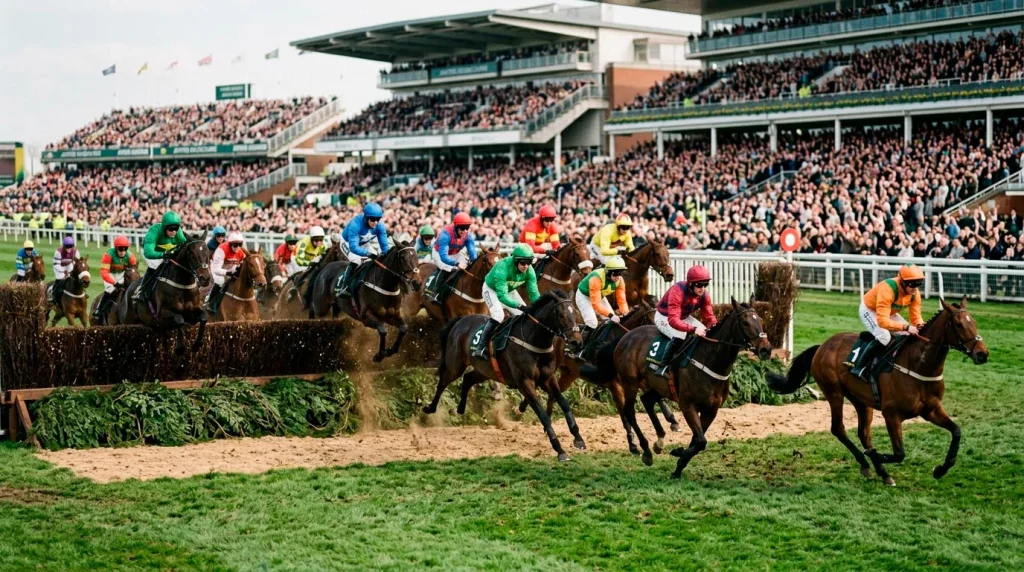
Grand National Each-Way Betting: Evolution of Historic Place Terms
The Grand National exists in its own betting weather. Every other race I price up the year over runs on form, ground, weight, draw. The National runs on a different system. Forty horses, four-and-a-quarter miles, thirty fences, a once-a-year audience that does not bet on anything else. Approximately £250 million was wagered on the 2025 Grand National weekend, with the single race alone generating 700% more betting activity than the Cheltenham Gold Cup according to Entain data. The Betting and Gaming Council’s chief executive Grainne Hurst summed up its cultural standing bluntly in April 2025: “The Grand National is one of the precious few sporting events in this country with the ability to unite the entire nation around a single spectacle. It is the nation’s punt.”
Each-way at the National is, for most of those 250 million pounds, the only bet that makes sense. Win-only on a 33/1 horse in a 40-runner staying chase over Aintree’s fences is more like a lottery ticket than a bet. Each-way is the format that makes the National’s field shape betable. The paid places on it have been the single most argued-over feature of UK each-way markets since the late 1990s, and the place line has stretched from four to seven over that period — sometimes back to six, depending on the operator and the year. That stretch is the operator’s marketing arms race playing out across the only race the casual UK punter actually watches.
Reading the National’s each-way menu is a different skill from reading any other race’s menu. The casual money distorts the win market; the place market behaves differently because of it. Knowing where the place value has actually sat over the years requires going back through the history of the place terms.
From 4 places to 7: a short history of GN place terms
The standard UK rulebook for handicaps of sixteen or more runners is four places at one quarter the odds. That is the rule that governs almost every big handicap in the British calendar — Wokingham, Stewards’ Cup, Ebor, November Handicap. For most of the twentieth century, the Grand National followed the same rule. Four places at one quarter the odds was the standard from the post-war rebuild of the off-course betting market through to the late 1990s.
The first major break with the standard came in the early 2000s. Operators began offering five paid places on the National as a promotion, initially as a Saturday-only special, then as a standing offer. The economic logic was straightforward: the National’s field shape — typically 38-40 runners with a deep tier of 20/1 to 50/1 shots — meant that paying an extra place barely cost the operator anything in expectation, while it bought meaningful marketing share among casual punters who only bet once a year.
By the mid-2010s, six paid places at one quarter the odds had become the de facto industry standard for the National. The progression to seven places at one fifth came later, in 2019 and 2020, as operators sought to differentiate further. Betfred was the first major UK firm to settle on seven places as a standing offer. For the 2025 Grand National, Betfred was the only major UK firm offering 7 places at 1/5 odds while most major firms offered 6 places. By the 2026 National, Sky Bet had matched the seven-place offer at 1/5 — advertised as the most generous of any major UK operator. Industry analysis estimates that an extra place on a 20-runner each-way race typically expands the place “net” by approximately 25%, and on a 40-runner National the marginal value of moving from six to seven places, while smaller in percentage terms, is still meaningful on long-priced runners.
Why a 40-runner field changes the place line
The structural reason the National can sustain six or seven paid places is the field. Forty horses produces a place market that is mathematically deeper than any standard handicap. A 40-runner field with seven paid places means 17.5% of starters finish in the frame. By comparison, a 16-runner handicap with four paid places puts 25% of starters in the frame, but the average price per starter is shorter. The National’s place line is, in a sense, less generous in percentage terms but more generous in price terms — because the field’s average price is so much longer.
The maths runs like this. In a typical Saturday handicap, the field averages 12-15 runners. The bookmaker’s overround on the place market is concentrated across that smaller pool. In a 40-runner National, the overround stretches across forty runners, which means the operator can afford to pay a longer-priced fraction on each individual horse because the structural margin is supported by the field’s depth. The longer the price you take on a National runner, the more this matters. A 33/1 each-way at 1/5 places at 6.6/1; a 50/1 each-way at 1/5 places at 10/1. Both are bigger absolute prices than any standard handicap place market would offer on the same horse.
The trade-off is settlement clarity. The National’s 30 fences and three-and-a-half miles of running over Aintree’s specific obstacles produce more fallers, unseats, and pulled-ups than any other race in the calendar. A typical National finishes with 12-18 horses still running. Paying seven places requires seven horses to actually complete the course; on years where attrition is high, the place market settles on whoever finishes, even if fewer horses complete than the paid-places line. The bookmaker is not refunding place stakes for “incomplete” places. The 13th to 40th finishers in a National where only 11 horses complete are simply unplaced, and their place stakes are gone.
2025 vs 2026: where the market settled
The two-year window of 2025 and 2026 captures the recent trajectory of National each-way terms. The 2025 Grand National ran with Betfred as the sole major UK operator offering 7 places at 1/5 odds. Most major firms — Bet365, William Hill, Coral, Ladbrokes, Paddy Power — landed on 6 paid places at 1/4 the odds. The split between the seven-place fraction-of-fifth and six-place fraction-of-fourth was the headline punter-side decision of the day. Industry analysis and operator-comparison data from StableBet pointed to the seven-place 1/5 being structurally better on horses priced 25/1 and longer; the six-place 1/4 offered better value on the 8/1 to 20/1 band.
By the 2026 Grand National, Sky Bet had matched Betfred’s seven-place offer at 1/5 odds — advertised as the most generous of any major UK operator that year. The industry-wide drift continued: more places offered, at a tighter fraction, on the National specifically. A 25/1 each-way slip at 7 places, 1/5, paid 5/1 on the place leg. The same horse at 6 places, 1/4, paid 25/4 on the place leg — a bigger price, but with one fewer paid place to land into.
The 2025 vs 2026 comparison also tracks the wider regulatory backdrop. Affordability checks have continued to thin the larger-staking punter base across the year, and operators have responded with more aggressive headline place-terms promotions on the National specifically as a way to recapture casual market share. The William Hill projection of approximately £450 million in total bets across the 2026 Cheltenham Festival captures one part of that competitive pressure; the Grand National’s standalone weekend turnover captures the other. Both meetings have become marketing battlegrounds where operators compete on extra-places generosity rather than on traditional advertising.
Value vs marketing: reading the operator menu
The most expensive each-way mistake a casual UK punter can make on the National is to assume “more places = more value”. Operators understand this and price their offers accordingly. A seven-place offer at 1/5 odds is not automatically more generous than a six-place offer at 1/4 odds; the price band of your horse decides which is better.
Run the maths on a 25/1 each-way bet, £10 stake each way. Seven places at 1/5: place leg pays 25/1 ÷ 5 = 5/1. £10 × 5 = £50 profit plus £10 stake = £60 from the place leg. Six places at 1/4: place leg pays 25/1 ÷ 4 = 6.25/1. £10 × 6.25 = £62.50 profit plus £10 stake = £72.50 from the place leg. The six-place 1/4 offer is structurally more generous in cash terms — by £12.50 on this bet — provided the horse finishes inside the top six rather than the top seven.
For the horse to be a winning seven-place bet but a losing six-place bet, it must finish exactly seventh. That is a narrow outcome. Across recent Nationals, roughly 12-18 horses complete the course on average, so the seventh place is sometimes deep into the tail of the finishers — by then several horses have been pulled up or fallen, and the seventh-placed runner is often comfortably home. But the structural point stands: a place line at 7 paid at 1/5 only beats 6 paid at 1/4 when your horse finishes seventh and not better. For the wider mechanics of how operators position extra-places promotions and how value depends on price band, the extra places +EV maths breakdown in the main cluster works through the full case. The marketing copy says “more places”. The maths says “more places at a worse fraction, sometimes”. Read the fraction before the count.
How many places do most UK operators pay on the Grand National?
Most major UK operators pay six places at one quarter the odds. A growing minority — including Betfred from 2025 and Sky Bet from 2026 — offer seven places at one fifth the odds. The standing rulebook for a 40-runner handicap would be four places at one quarter; the National"s extra places are operator promotions on top of that floor.
When did 6 places at the Grand National become standard?
Six places at one quarter the odds became the de facto industry standard for the Grand National in the mid-2010s, after a decade of operator promotions stretched the standing four-place floor first to five and then to six paid places. The shift was driven by operator marketing competition rather than any rulebook change.
Are 7 places ever worse value than 6 with better fractions?
Yes, depending on your horse"s price. Seven places at 1/5 pays a shorter fraction than six places at 1/4. On a 25/1 each-way, six places at 1/4 pays more per pound of place stake than seven places at 1/5 — unless your horse finishes specifically seventh, in which case only the seven-place offer collects.
Articles
Prepared by the Racing Place Betting editorial staff.
